
In our knowledge share, we have discussed BREEAM 7 launch already and the way it represents a significant shift in how sustainability performance is defined and assessed within the built environment. The updated scheme places far greater emphasis on whole-life outcomes, credible evidence, and long-term value, moving beyond short-term compliance and isolated credit achievement.
And today, we’d like to focus on how ADW Developments integrated it into our practice. We provide specialist consultancy support to help project teams navigate BREEAM Version 7 with clarity and confidence. Our approach integrates whole life carbon, life cycle costing and circular economy thinking directly into project decision-making, ensuring BREEAM functions as a strategic framework rather than an administrative burden.
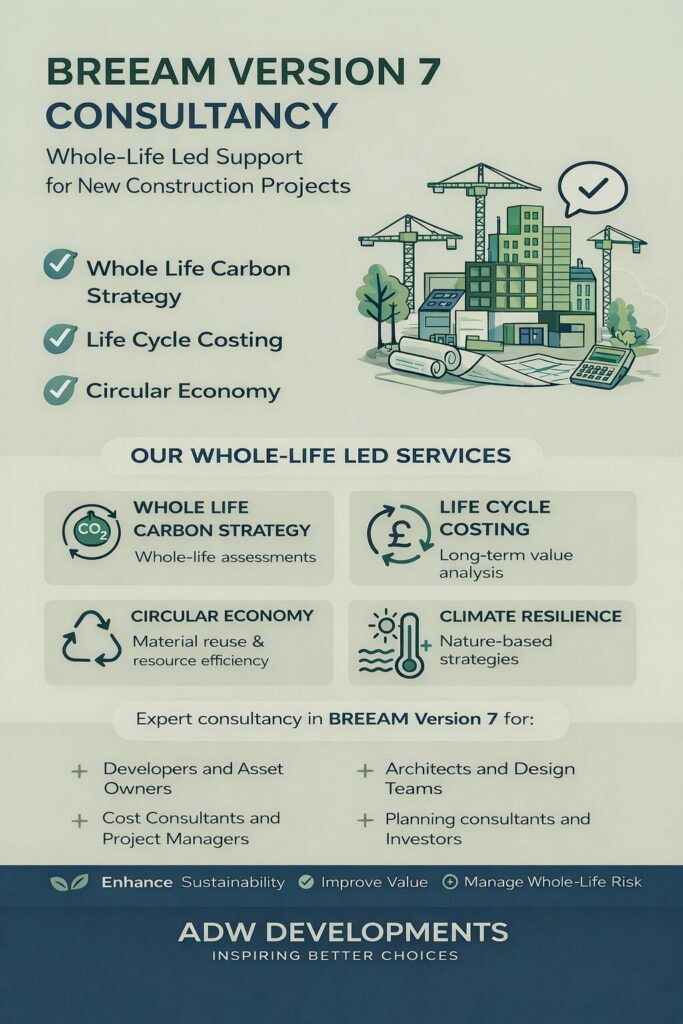
Why BREEAM Version 7 Requires a Different Approach
As already discussed, BREEAM Version 7 is not a minor revision to previous versions. It introduces a more outcome-focused methodology, including:
- Stronger expectations around whole life carbon performance
- Greater scrutiny of evidence quality, assumptions and data sources
- Increased focus on climate resilience, ecology, and long-term performance
- Closer alignment with planning policy and investor reporting requirements
Projects that rely on late-stage sustainability inputs often encounter redesign, cost pressure and programme risk. ADW Developments works upstream, embedding Version 7 requirements from feasibility and early design stages to ensure sustainability, cost and programme remain aligned.
Our BREEAM Version 7 Consultancy Services
ADW Developments does not act as a licensed BREEAM Assessor. Instead, we provide independent technical consultancy that supports clients, design teams and assessors by delivering thotough analysis, evidence and strategic alignment.
Whole Life Carbon Strategy
We support compliance with Version 7’s strengthened carbon requirements through:
- Whole Life Carbon assessments aligned with RICS guidance and EN 15978
- Embodied carbon modelling covering structure, envelope, internal elements and services
- Operational carbon analysis based on realistic energy demand profiles
- Options testing to inform design, specification and procurement decisions
Carbon is treated as a decision-making tool, not simply a reporting exercise.
We also provide independent third-party verification under Mat 01, ensuring methodology, assumptions, and reporting meet the highest standards for audit and compliance.
Moreover, to close the loop on performance, ADW supports Post-Occupancy Evaluation (POE), helping clients understand how buildings operate in use, identify gaps, and apply lessons to improve long-term sustainability and asset performance.
Life Cycle Costing Integration
We align BREEAM outcomes with long-term commercial performance through:
- Life Cycle Cost Analysis linked to carbon and specification choices
- Trade-off analysis between capital cost, operational cost, maintenance and replacement
- Support for business cases, funding submissions and investor reporting
This approach ensures sustainability strategies deliver long-term value, not unintended cost risk.
Circular Economy and Resource Strategy
We support Version 7 material and resource requirements through:
- Circular Economy Statements aligned with UK planning policy
- Material efficiency and adaptability assessments
- Strategies for reuse, recoverability and future flexibility
- Structured engagement with supply chains and manufacturers
Climate Resilience and Risk Support
We assist teams in addressing future climate risks by supporting:
- Overheating risk strategies aligned with future climate scenarios
- Flood and water resilience considerations
- Durability and maintainability reviews
- Long-term performance thinking beyond minimum compliance
Third-Party Verification (Mat 01)
BREEAM Version 7 places greater emphasis on the credibility of Whole Life Carbon assessments. Independent third-party verification under Mat 01 can help demonstrate robust methodology, transparent assumptions and alignment with recognised standards such as RICS and EN 15978. ADW Developments supports teams by preparing clear, verification-ready carbon evidence.
Post-Occupancy Evaluation (POE)
BREEAM Version 7 also highlights the value of learning from in-use performance. Post-Occupancy Evaluation (POE) helps bridge the gap between design intent and operational outcomes, supporting continuous improvement and long-term asset performance.
How We Work
Our approach is collaborative, structured and evidence-led, focusing on reducing risk and improving decision-making.
- Early engagement from feasibility or RIBA Stage 1
- Close coordination with architects, engineers, cost consultants and planners
- Clear documentation aligned with BREEAM Version 7 evidence requirements
- Ongoing technical support through design development
Who This Service Is For
Our BREEAM Version 7 consultancy supports:
- Developers and asset owners
- Architects and design teams
- Cost consultants and project managers
- Planning consultants preparing submissions
- Investors seeking credible sustainability performance
FAQs
Do ADW Developments act as the BREEAM Assessor?
No. ADW Developments provides independent sustainability consultancy and technical support. The licensed BREEAM Assessor remains responsible for certification.
When should we engage support for Version 7?
Ideally at feasibility or early concept stage. Early engagement reduces redesign risk and improves alignment between sustainability, cost and programme.
Can you support projects transitioning from Version 6.1?
Yes. We advise on registration strategy, transition risk and the long-term implications of remaining on Version 6.1 versus adopting Version 7.
Is whole life carbon mandatory under Version 7?
Whole life carbon is embedded across multiple credits. Projects are expected to provide credible lifecycle analysis supported by transparent methodology and data.
Why ADW Developments
ADW Developments specialises in whole-life thinking across sustainability, cost, and circular economy strategy. We focus on clarity, evidence, and long-term value. Our work also supports successful planning, investor confidence, and resilient asset performance.
To discuss how BREEAM Version 7 applies to your project or portfolio, contact ADW Developments today.