
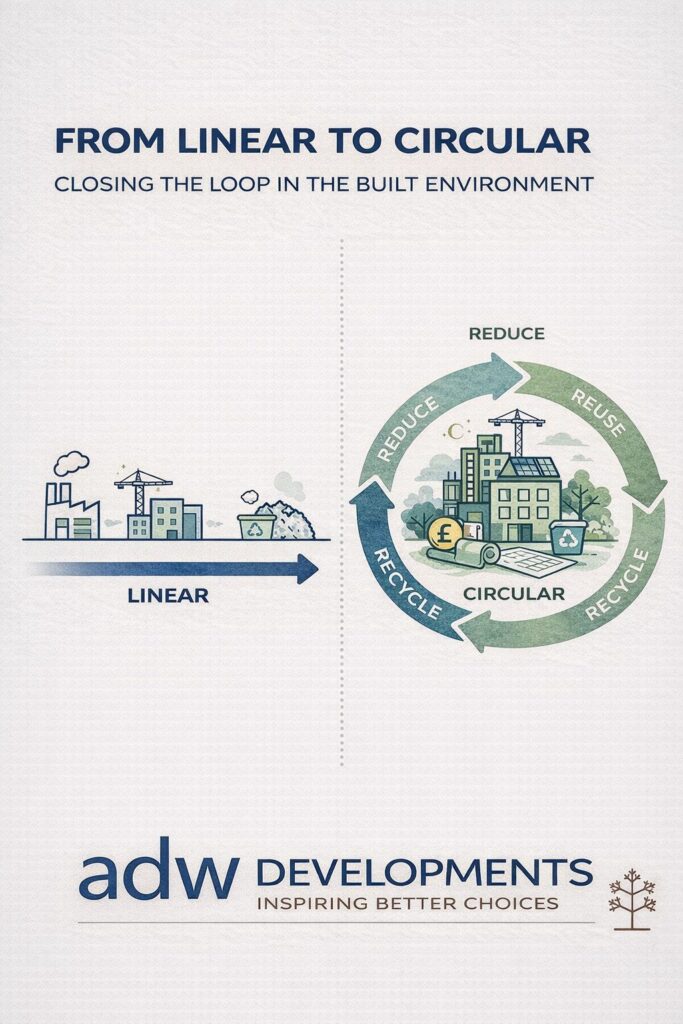
The circular economy marks a decisive break from the construction industry’s outdated linear model. For decades, the built environment has followed a simple pattern of extracting resources, building, demolishing, and discarding. But with growing pressure from climate change, material shortages, rising costs, and tighter regulation, that approach is no longer fit for purpose.
A circular approach offers a smarter, more resilient alternative. By designing buildings for longevity, reuse, and adaptability and keeping materials in circulation for as long as possible, the industry can cut waste, lower environmental impact, and unlock long-term value. At ADW Developments, we believe that inspiring better choices at every stage of the project lifecycle is what delivers buildings that perform today and endure for the future.
What Is the Circular Economy in Construction?
In the built environment, a circular economy is not simply about recycling at the end of a building’s life. It requires rethinking the entire lifecycle. From concept design through to deconstruction.
Key principles include:
- Designing for disassembly and flexibility
- Using materials with recycled content and clear reuse pathways
- Reducing waste at every stage
- Retaining value in components, products and structures
- Tracking materials through digital tools or material passports
This shift enables developers, designers and contractors to treat buildings as material banks rather than disposable, one-off assets.
Why Circular Thinking Matters
Environmental benefits
- Lower embodied carbon
- Reduced extraction of virgin materials
- Less waste sent to landfill
- Improved biodiversity and ecosystem outcomes through responsible sourcing
Economic benefits
- Lower procurement costs where reused or reclaimed materials are viable
- Reduced waste disposal and landfill charges
- Stronger ESG performance and increased investor confidence
- More resilient supply chains
Regulatory benefits
Policies such as GLA Policy SI7 Circular Economy require Circular Economy Statements for major developments in London. Similarly, schemes such as BREEAM reward material efficiency, waste minimisation, and design for disassembly.
Embedding circular principles early helps developers remain compliant, competitive, and future-ready.
Practical Circular Strategies for Projects
Circular economy thinking can be embedded at every stage of development:
Design stage
- Modular design
- Mechanical fixings instead of permanent bonds
- Designing for adaptability and future repurposing
Procurement
- Prioritising products with recycled content
- Working with suppliers offering take-back or remanufacturing schemes
- Selecting durable, repairable components
Construction
- Minimising off-cuts and material waste
- Using standardised elements
- Reusing materials from site or nearby developments
End of life and deconstruction
- Salvaging high-value components
- Sorting materials for reuse and recovery
- Using digital inventories to support future material recovery
How ADW Developments Supports Circular Economy Integration
At ADW Developments, we support clients in embedding circular principles across their projects through the following services:
Circular Economy Statements
Clear, evidence-based reports demonstrating how schemes reduce waste, maximise reuse potential, and meet planning policy requirements.
Material Efficiency and Waste Reduction Strategies
Targeted assessments identifying opportunities to reduce material consumption and improve lifecycle value.
Pre-Demolition Audits (PDAs)
Audits that identify reusable materials, salvage opportunities, and potential cost recovery before demolition.
Life Cycle and Whole Life Carbon Assessments
Analysis of the carbon impacts associated with materials and construction processes, supporting low-carbon, circular decision-making.
Together, these services help clients move from ambition to practical implementation, ensuring projects deliver value well beyond initial construction.
Challenges and How to Overcome Them
Circular construction presents challenges, including:
- Limited availability of reused materials
- Perceptions of higher upfront cost
- Lack of material traceability in existing buildings
- The need for early-stage coordination across disciplines
- Supply chain reluctance to adopt new practices
However, these barriers can be overcome. Early engagement, clear objectives, and assessments, such as life-cycle assessment, whole-life carbon, and material-efficiency studies, allow project teams to develop circular strategies that are both practical and deliverable.
Looking Ahead
As pressure increases to reduce embodied carbon and construction waste, the transition from linear to circular construction is no longer optional; it is inevitable.
By adopting circular economy principles, developers can deliver buildings that are:
- More adaptable
- More resource-efficient
- Lower in carbon
- Higher in long-term value
- Better aligned with emerging regulation
At ADW Developments, we are committed to helping clients move confidently towards a circular, resource-efficient future. Contact us today to find out how we can help.