
Artificial intelligence is reshaping the construction and development sector at pace. From early-stage cost planning to tender preparation, the capability on offer today is genuinely useful.
As a result, as organisations adopt AI more broadly, they face a deeper question, one that goes beyond features and functionality and defines how they build and protect competitive advantage:
Who controls your data?
For most firms using commercial AI platforms, the answer is uncomfortable. The data you input, project intelligence, cost benchmarks, tender strategies, internal processes, may not remain yours alone.
The Risk with Off-the-Shelf AI
Commercial AI tools are built for scale. They serve thousands of users across multiple industries, and that breadth is precisely the problem. When your team inputs sensitive project data into a shared platform, that information enters an environment you do not control.
In many cases, depending on platform terms of service, providers may retain your data or use it to improve shared models that your competitors can access on equal terms. As a result, the benchmarks, pricing logic, and procurement strategies your organisation has refined over years of project delivery could quietly inform a pool of shared intelligence.
In a sector where margins are tight and differentiation is hard-won, that is a meaningful exposure. Specifically, the risks are practical:
- Confidential project data may be retained outside your environment
- Internal cost benchmarks and pricing intelligence can be inadvertently shared
- Tender strategies and procurement logic may be accessible beyond your organisation
- There is no audit trail for how your data is used once submitted
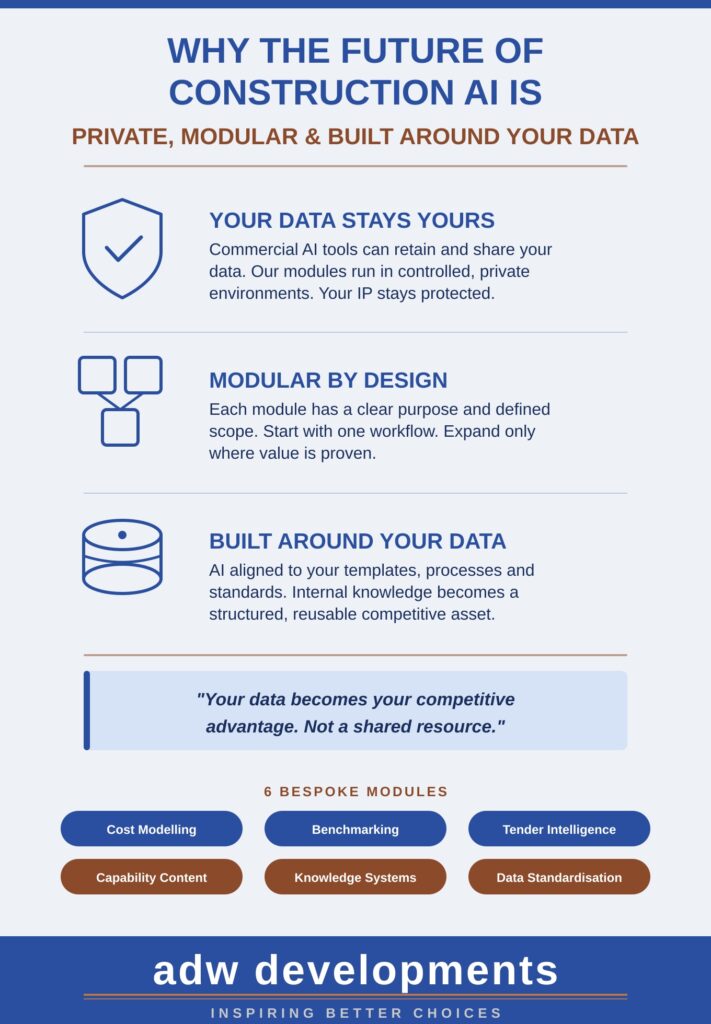
Your data becomes your competitive advantage not a shared resource.
A Different Approach: Private, Governed AI Modules
Rather than adopting general-purpose AI tools, a growing number of organisations are choosing to deploy purpose-built AI modules that operate within their own environment. These systems are designed around the organisation’s existing data, templates, and working practices, not the other way around.
At ADW Developments, this is precisely what we build. Our modular AI and LLM systems are bespoke by design. Each module is scoped to a specific function, aligned with existing terminology and reporting formats, and deployed within controlled environments where intellectual property remains protected.
Critically, these are not transformation programmes. They are practical interventions. A single module can be scoped, delivered, and evaluated quickly, generating measurable value before any wider rollout is considered.
What the Modules Do
Each module has a defined purpose and clear operational boundaries. Depending on organisational priorities, typical applications include:
Parametric Cost & Market Adjustment Engine.
Rapid early-stage cost modelling supported by market adjustment factors, built on your own project cost data rather than generic published indices.
Benchmarking & Cost Intelligence Platform.
Structured access to internal benchmarking data and historic project intelligence, enabling consistent cost comparison across schemes and procurement routes.
Bid & Tender Intelligence Assistant.
Preparation of structured tender responses aligned with submission criteria and scoring frameworks, drawing on your previous submissions and project experience.
Capability & Marketing Content Generator.
Consistent production of capability statements and case studies that accurately reflect your project track record and service offer.
Project Knowledge & Lessons Learned System.
Capture and retrieval of project insights, key decisions, and outcomes,, preserving institutional knowledge as a structured, searchable asset rather than allowing it to disperse over time.
Structured Data Extraction & Standardisation.
Conversion of unstructured reports and documentation into standardised datasets, reducing manual rework and improving consistency across project records.
Where required, organisations can deploy modules within private cloud environments, self-hosted AI models, or fully offline systems. This ensures organisations retain full control of sensitive data whilst still benefiting from modern AI capability.
Starting Small, Building Value
The right entry point is usually a single workflow that creates repeated friction. From there, we scope a module around that problem, deliver it quickly, and evaluate it in practice. Then, expansion follows only where value has been demonstrated.
Small modules. Clear purpose. Practical outcomes.
If there is a workflow in your organisation that would benefit from this kind of structured intervention, we would be glad to discuss what a first module might look like.