
On the International Day of Women and Girls in Science, we celebrate curiosity, innovation, and the power of future talent to shape a better world. For the built environment, this is more than a moment of recognition; it is a reminder that the path to a net zero, resilient future depends on those who will design, analyse, and deliver it.
The buildings and infrastructure of tomorrow will require new skills, new thinking, and new perspectives. Encouraging girls to engage with science today helps ensure that the built environment remains innovative, adaptable, and ready to meet the challenges ahead.
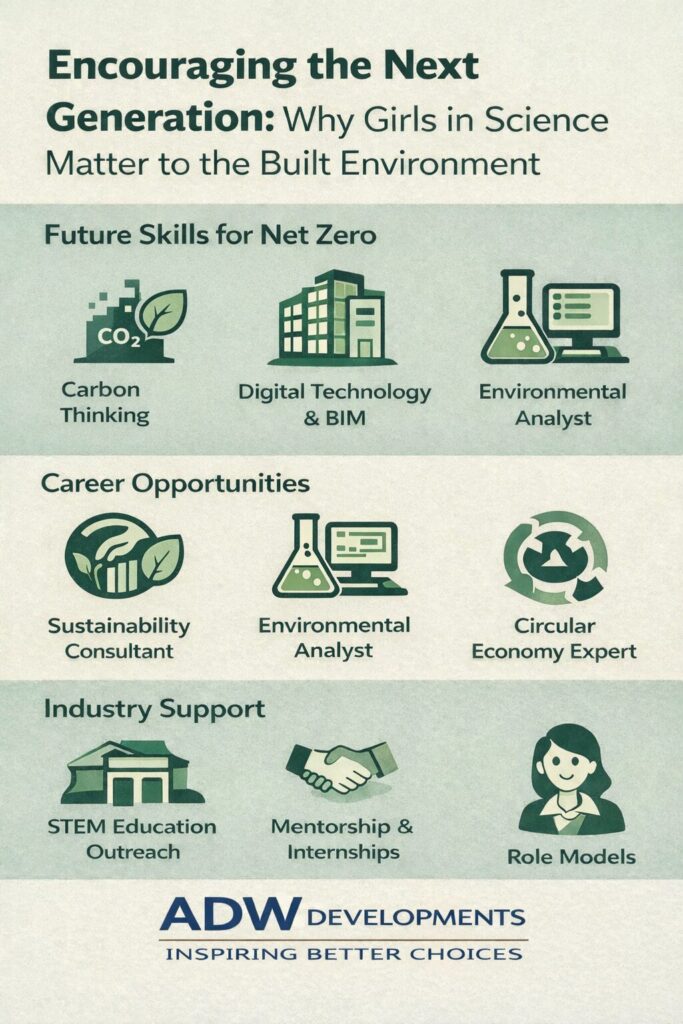
Future Skills for a Net Zero Built Environment
Delivering net zero buildings is one of the most important and exciting challenges facing our sector. It requires a combination of technical expertise, scientific understanding, and creative problem-solving.
Increasingly, the industry depends on skills such as:
Whole life carbon assessment
Understanding the environmental impact of materials and buildings across their entire lifecycle is becoming essential. Scientific thinking allows professionals to interpret data, evaluate materials, and make choices that reduce carbon while maintaining performance.
Digital modelling and performance analysis
Tools such as Building Information Modelling (BIM) and digital twins allow us to simulate, measure, and improve building performance. These technologies rely on strong analytical and scientific foundations to optimise efficiency and long-term outcomes.
Material innovation and circular economy thinking
From low-carbon concrete alternatives to material reuse strategies, scientific research is driving innovation. These advances help reduce waste, conserve resources, and support a more circular built environment.
Environmental and climate systems understanding
As climate pressures increase, buildings must become more resilient. Knowledge of energy systems, environmental science, and sustainability principles enables better, more future-ready design.
Girls pursuing science today are developing exactly the skills that will enable these solutions tomorrow.
A Wider World of Built Environment Careers
The built environment has evolved far beyond its traditional boundaries. It now brings together environmental science, digital technology, engineering, and data analysis to improve how buildings are designed, delivered, and perform over time. Career pathways now include:
- Sustainability and Whole Life Carbon Consultants
- Environmental and Climate Analysts
- Digital Construction and BIM Specialists
- Building Performance and Energy Modellers
- Circular Economy and Materials Specialists
- Environmental Researchers and Innovators
These roles are shaping how buildings perform, how materials are selected, and how projects contribute to climate goals. They offer meaningful opportunities to combine scientific knowledge with real-world impact.
For girls interested in science, the built environment offers careers where they can help tackle one of the defining challenges of our time.
Diversity Drives Innovation and Resilience
Delivering a net zero built environment will require new ideas, rigorous analysis, and the ability to challenge established approaches. Diverse teams bring broader perspectives, stronger creativity, and better outcomes.
Encouraging girls into science is not simply about improving representation; it is about strengthening the capability of the entire sector. The industry’s future depends on people who can interpret evidence, understand complex systems, and develop solutions that perform not just today, but over the full lifecycle of a building. A broader talent base brings deeper insight, stronger innovation, and more resilient outcomes.
When young people see that there is a place for them in the built environment, it expands what they believe is possible.
Inspiring Interest Early: The Role of Industry
Building future talent starts long before careers begin. Early exposure to science, sustainability, and real-world applications helps young people connect their learning to meaningful outcomes.
Industry can play a powerful role by:
- Supporting STEM outreach in schools
- Offering mentorship, placements, and internships
- Sharing knowledge and career pathways
- Promoting visible role models
- Demonstrating how science directly contributes to climate solutions
These actions help transform curiosity into confidence, and confidence into careers.
At ADW Developments, we recognise that the future performance of the built environment depends on the knowledge and capability we help cultivate today. Supporting scientific curiosity and creating visible pathways into the industry ensures that the next generation is prepared to tackle the environmental and technical challenges that lie ahead. Encouraging girls to pursue science is not only an investment in individual opportunity, but in the long-term resilience, capability, and sustainability of the built environment itself.
On the International Day of Women and Girls in Science, we celebrate their ambition, their potential, and the vital role they will play in shaping a net zero future.