
The built environment is entering a data-driven era where material intelligence is becoming as critical as design and cost.
As net zero targets tighten and circular economy principles move into regulation, the focus is shifting beyond how buildings are designed to understanding exactly what they are made from, how those materials perform, and how they can be recovered, reused, or optimised over time.
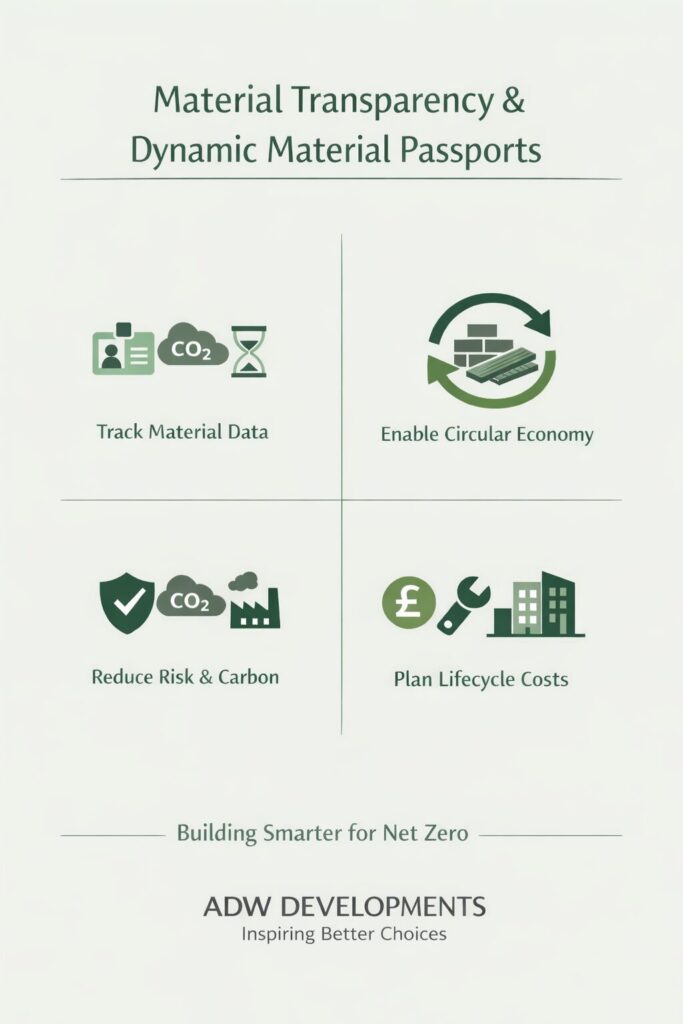
Material transparency and dynamic material passports sit at the centre of this shift. They transform fragmented product data into a structured, evolving asset resource, enabling better decisions, reducing exposure to risk, and unlocking measurable improvements in whole life performance.
Why Material Transparency Now Matters More Than Ever
Construction materials account for a significant proportion of whole life carbon emissions, particularly within Modules A1–A5 (product and construction stages) and Module C (end-of-life), as defined under EN 15978.
However, embodied carbon is only part of the picture.
Material choices also influence:
- Resource depletion
- Toxicity and indoor environmental quality
- Circularity potential
- Regulatory compliance
- Long-term asset adaptability
Historically, material information has been fragmented, inconsistent, or difficult to access beyond design and construction.
This creates risk.
Without reliable data, asset owners and investors struggle to:
- Verify embodied carbon claims
- Assess exposure to future regulatory change
- Understand reuse and recovery potential
- Demonstrate ESG performance with confidence
Material transparency addresses this challenge by making environmental and technical data accessible, structured and verifiable.
What Is a Material Passport?
A material passport is a structured dataset that records key information about a product or component installed within a building.
It typically includes:
- Product identification and manufacturer details
- Environmental performance data (e.g. Environmental Product Declarations)
- Embodied carbon metrics
- Material composition
- Maintenance requirements
- Expected service life
- Disassembly and reuse guidance
When aggregated at building level, material passports create a digital record of the materials embedded within an asset.
This supports whole life carbon assessments, life cycle costing and circular economy strategies.
From Static Records to Dynamic Material Passports
Traditional documentation is static, produced at completion and rarely updated.
Dynamic material passports go further.
They evolve over time, reflecting:
- Refurbishment works
- Component replacement
- Performance upgrades
- Maintenance interventions
- Changes in operational strategy
By linking passport data to digital asset management systems and BIM environments, information remains live and actionable.
This enables asset owners to manage buildings as material banks rather than fixed structures.
In practice, this supports:
- More accurate whole life carbon modelling
- Improved forecasting of replacement cycles
- Identification of reuse opportunities
- Reduced waste at refurbishment and demolition
Dynamic passports therefore bridge the gap between design intent and operational reality.
Supporting Circular Economy Objectives
The circular economy aims to retain material value for as long as possible.
In the built environment, this requires visibility.
Without knowing what materials are present, in what quantities, and in what condition, reuse at scale is difficult to achieve.
Material passports support circularity by:
- Enabling selective disassembly
- Identifying high-value recoverable components
- Supporting secondary material markets
- Reducing reliance on virgin resource extraction
- Improving end-of-life planning
As regulatory focus increases on waste reduction and embodied carbon disclosure, this level of transparency becomes strategically important.
Reducing Regulatory and Investor Risk
Disclosure frameworks and performance standards are evolving rapidly.
Net zero pathways, whole life carbon reporting requirements and emerging building standards increasingly require credible, verifiable data.
Material transparency strengthens compliance by:
- Supporting accurate carbon reporting
- Demonstrating supply chain due diligence
- Reducing greenwashing risk
- Improving alignment with ESG frameworks
- Enhancing audit readiness
For institutional investors and portfolio managers, this improves confidence in asset resilience.
Buildings with transparent material data are better positioned to respond to future regulation, carbon pricing mechanisms and circular economy policy shifts.
Linking Material Data with Lifecycle Costing
Material performance not only affects carbon outcomes but also influences long-term costs.
Service life, maintenance cycles, durability and adaptability all impact operational expenditure and capital replacement planning.
Integrating material passport data into lifecycle costing models allows asset managers to:
- Forecast replacement costs more accurately
- Identify cost-effective low-carbon alternatives
- Optimise maintenance strategies
- Reduce unexpected capital expenditure
- Protect long-term asset value
This alignment between environmental data and financial modelling strengthens decision-making at both project and portfolio level.
Practical Implementation Considerations
While the concept is clear, implementation requires structured processes.
Key considerations include:
- Early specification of data requirements
- Alignment with recognised data standards
- Integration with BIM and asset management systems
- Supply chain engagement
- Ongoing data governance
The quality of output depends on the quality of input.
Clear information requirements at procurement stage are critical to ensure usable, consistent data.
From Compliance Exercise to Strategic Advantage
Material transparency should not be treated as an administrative burden.
When embedded within asset strategy, it becomes a performance tool.
It enables:
- Lower embodied carbon
- Improved circularity
- Greater operational insight
- Reduced transition risk
- Stronger ESG positioning
As net zero strategies mature, the ability to understand and manage material data will increasingly differentiate high-performing assets from those exposed to regulatory and market risk.
Supporting Long-Term Asset Resilience
At ADW Developments, we support better decision-making through robust life cycle costing, whole life carbon assessments, and circular economy analysis.
Contact us today to discuss how we can support your project.