
Are you a building owner, developer, or sustainability professional navigating the path to net zero? This post breaks down the UK Net Zero Carbon Buildings Standard (NZCBS) into clear, actionable insights to help you understand its impact and prepare for compliance. Understanding the NZCBS early allows you to make informed decisions that protect asset value, reduce risk, and align with future regulatory and market expectations.
As this is a broad and important topic, we’ll be exploring it in more detail over the coming weeks, so do stay tuned. This series will help translate the Standard into practical, asset-level actions.
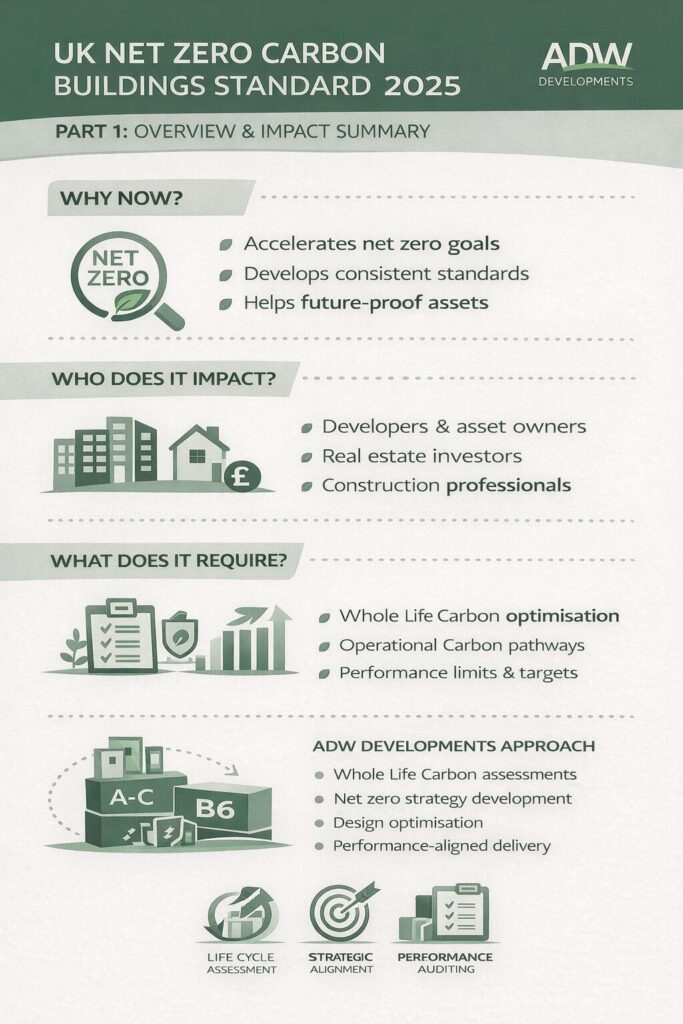
Why the UK Net Zero Carbon Buildings Standard Matters in 2025
Climate change is transforming how we design and manage buildings, and rightly so. With the built environment responsible for around 40% of the UK’s carbon emissions, it’s a key focus in the push to net zero. This makes buildings one of the most important and immediate opportunities for meaningful carbon reduction.
Launched in September 2024 and updated in April 2025, the UK Net Zero Carbon Buildings Standard (NZCBS) offers a much-needed, unified definition of what ‘net zero carbon’ means for UK buildings. Developed by a coalition of professional bodies and sustainability experts, it replaces fragmented guidance with one clear, industry-backed framework. This shift brings consistency, credibility, and measurable performance expectations across the sector.
Whether you’re developing new projects, managing existing stock, or advising clients, understanding the NZCBS is fast becoming essential to future-proof your assets. It will increasingly influence design decisions, investment strategies, and long-term asset performance.
Ready to turn policy into action? Read on to discover what the NZCBS covers, its requirements, and how to prepare your buildings for compliance. Early alignment provides a strategic advantage as the industry transitions toward performance-based net zero delivery.
What is the UK Net Zero Carbon Buildings Standard?
The UK Net Zero Carbon Buildings Standard (NZCBS) is a clear, industry-wide framework that defines what it means for a building in the UK to be ‘Net Zero Carbon Aligned’. Unlike past approaches, which were often inconsistent, the NZCBS was developed jointly by professional institutions, industry groups, and sustainability experts to bring clarity and consistency across the sector. It establishes a common benchmark that enables reliable comparison, reporting, and verification of building performance.
The Big Picture: Three Core Elements of NZCBS
At its core, the NZCBS does three crucial things:
- Defines what “net zero carbon” actually means for different building types
- Sets science-based performance targets that align with the UK’s carbon budgets
- Establishes a verification methodology based on measured, real-world performance
What makes this standard especially effective is its focus on evidence and performance. Instead of vague claims or greenwashing, buildings must demonstrate their net zero status using measured data from at least 12 months of operation.
When Was the NZCBS Launched?
The Pilot Version was launched in September 2024, with the latest revision published in April 2025. This means it’s hot off the press and represents the most current thinking on net zero buildings in the UK.
What Buildings Does the NZCBS Cover?
The NZCBS applies to a wide range of building types across the UK, making it relevant for most property professionals. Here’s a quick breakdown of what’s included. The breadth of coverage means the Standard will influence decisions across nearly the entire built environment.
13 Building Types Covered by NZCBS:
- Commercial Residential
- Culture and Entertainment
- Data Centres
- Healthcare
- Higher Education
- Homes
- Hotels
- Offices
- Retail
- Schools
- Science and Technology
- Sport and Leisure
- Storage and Distribution
New vs. Existing Buildings: Different Requirements
Here’s where things get interesting:
Here’s where things get interesting:
New Buildings must meet absolute limits on: delivered space heating and cooling (annual kWh/m² and peak W/m²), total operational energy demand, on-site renewable generation. These limits directly shape design strategy, system selection, and long-term building performance.
Existing Buildings currently have a lighter touch: must report performance metrics, not (yet) held to mandatory operational limits, will need to meet 2040 targets for any major retrofits. This creates a clear trajectory for performance improvement across existing portfolios.
Data Centres get special treatment: required to report all metrics, currently exempt from heating/cooling limits. This reflects their unique operational characteristics and high energy intensity.
In our next post, we’ll be covering the following topics:
Breaking Down Carbon: What Emissions Does NZCBS Track?
Embodied Carbon Benchmarks: The Numbers You Need to Know
Key NZCBS Requirements: What Building Owners Need to Know
These topics will provide practical guidance to help translate the Standard into actionable strategies.