
The value of a Pre-Demolition Audit has never been about the document itself. It comes from the decisions that the audit allows project teams to make.
When teams undertake the audit early, they can identify reuse opportunities, inform demolition strategy, support circular economy objectives, and improve the quality of project data before major decisions are fixed. When they leave it too late, many of those opportunities disappear.
That’s why timing matters. The question is not whether the team should undertake a Pre-Demolition Audit. The question is whether the team commissions it early enough to use the information it provides.
Understanding that distinction is essential to unlocking the full value of the process.
What a PDA Is Not
There is a version of the Pre-Demolition Audit that circulates in many project teams as a compliance document. It is brief, often generic, and submitted alongside a planning application to satisfy GLA Policy SI 7 or a similar local authority requirement.
That version fulfils an administrative requirement. It rarely influences procurement, specification, or programme. And it leaves most of the value on the table.
A PDA done properly is more than a quantified material inventory. It combines a detailed assessment of material quantities with an evaluation of reuse, recycling, recovery, and disposal opportunities.
It identifies what is in the building, its condition, and its potential for reuse, recycling, or recovery. Moreover, it and maps that materials teams can directly reuse, which require processing before reuse, which have recycling value, and which will cost money to dispose of. The outcome is a structured report that informs four things: procurement, cost planning, programme sequencing, and waste compliance.
The Construction Economics Argument
From a construction economics perspective, a PDA influences three key cost drivers: disposal costs, material recovery value, and future procurement expenditure.
1. Reduced disposal and landfill cost
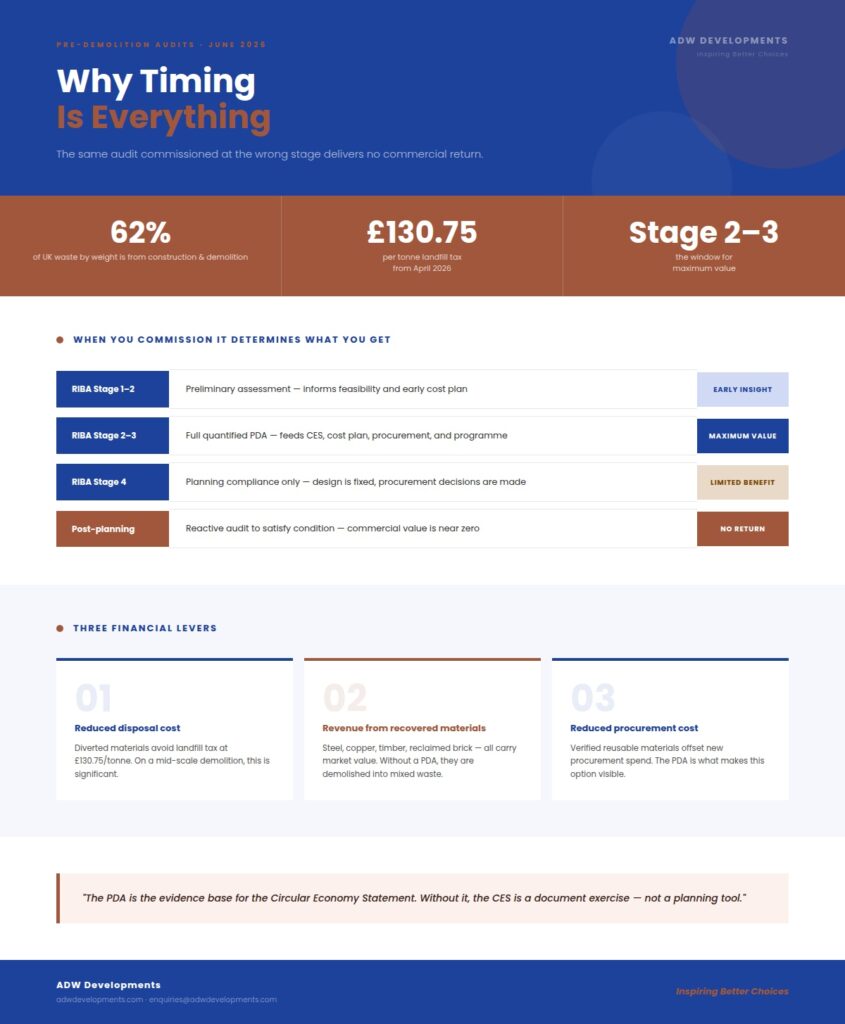
Construction waste going to landfill carries the UK Landfill Tax. As of 2026, the standard rate is £130.75 per tonne for active waste. On a medium-scale demolition of a commercial building, material volumes can run to several hundred tonnes. Without a PDA, project teams often fail to identify these materials as saleable assets. They demolish them into mixed waste and lose the opportunity.
A PDA identifies what can be diverted and how. That diversion has a direct cost saving.
2. Revenue from recovered materials
Steel, copper pipework, structural timber in good condition, aluminium curtain walling, bathroom and kitchen units, external paving, and reclaimed brick all carry market value. Secondary steel trades at a fraction of primary steel cost but still represents income or offset against procurement. Reclaimed brickwork, in particular, commands a premium in certain markets.
Without a PDA, project teams often fail to identify these materials as saleable assets. They demolish them into mixed waste and lose the opportunity.
3. Reduced new material procurement cost
Where project teams incorporate materials from the existing building into the new scheme, they offset procurement spend.
Subject to testing, verification, and design requirements, structural steel can often be reused in both primary and secondary structural applications.
Reclaimed timber has a role in fit-out.
Aggregate from crushed concrete can replace primary aggregate in certain groundworks applications.
The cost savings here depend on the material and the project. But the PDA is the mechanism that makes it visible. Without the audit, teams rarely evaluate these options.
In commercial development, a PDA conducted at RIBA Stage 2 or early Stage 3 feeds directly into the cost plan. Conducted at Stage 4 or later, the same information arrives too late to influence procurement decisions.
| In commercial development, a PDA conducted at RIBA Stage 2 or early Stage 3 feeds directly into the cost plan. Conducted at Stage 4 or later, the same information arrives too late to influence procurement decisions. |
Where the PDA Sits in the Programme
Timing is the variable that most affects commercial value. An audit done at the right stage opens options. An audit done too late closes them.
| RIBA Stage | PDA activity | Commercial relevance |
| Stage 1–2 | Preliminary desktop and site assessment | Informs feasibility. Identifies major material volumes and potential hazardous material presence. Feeds early cost plan assumptions. |
| Stage 2–3 | Full quantified PDA | Maximum commercial value. Material reuse options can influence structural or specification choices. Feeds Circular Economy Statement for planning. Informs cost plan and programme. |
| Stage 4 | PDA to support planning compliance | Limited commercial benefit. Design is fixed. Procurement decisions are made. Audit addresses planning requirement but does not feed procurement or specification. |
| Post-planning | Reactive audit to satisfy condition | Compliance only. Commercial value is near zero. This is the audit that should not happen, and often indicates that the requirement was not anticipated at brief stage. |
Planning Requirements: What Has Changed
The requirement for a Circular Economy Statement, which a PDA feeds, is no longer limited to London. The GLA has required a CES for major developments since March 2021 under London Plan Policy SI 7. Several local planning authorities outside London now include similar requirements in their local plans, and the direction of travel from national planning policy is clear.
A common mistake at pre-application stage is for project teams to treat the CES as something they can write retrospectively from the design. They cannot. The CES needs to demonstrate how they have considered materials from the existing building as a resource. Without a PDA, that demonstration lacks evidence.
A planning condition that requires a CES after permission has been granted can create a specific problem where no PDA was undertaken: the project team may already have contracted demolition, making targeted deconstruction harder to deliver. The audit then becomes a document exercise rather than a planning tool.
| The PDA is the evidence base for the CES. Treating them as separate documents, commissioned at different times and by different consultants, is one of the most common and most avoidable inefficiencies on major developments. |
The Whole Life Carbon Connection
A Pre-Demolition Audit does not sit in isolation from the wider whole life carbon picture.
Material reuse identified through a PDA can influence several lifecycle modules within a Whole Life Carbon Assessment, particularly Modules A1-A5, C and D, depending on the assessment boundary and reuse strategy.
Where project teams reuse structural or material elements from the existing building within the new development, those elements carry significantly lower embodied carbon than their new-build equivalents.
The audited and verified material inventory enables practitioners to make this claim robustly within a WLC assessment.
This matters commercially because the GLA and a growing number of local planning authorities now require or encourage Whole Life Carbon reporting as part of the planning process.
A project that can demonstrate meaningful material reuse from a verified PDA is in a stronger position on WLC than one that cannot.
What a Good PDA Delivers
The output of a properly conducted Pre-Demolition Audit should do the following:
- Provide a quantified material inventory by element, including estimated volumes or weights
- Assess condition and suitability for direct reuse, secondary use, or recycling
- Identify hazardous materials requiring specialist handling, including asbestos, lead paint, and contaminated materials
- Estimate disposal costs and potential recovery income by material type
- Make specific recommendations on deconstruction methodology and sequencing
- Produce data in a format that feeds directly into the Circular Economy Statement and cost plan
- Be completed and signed off before demolition contracts are let
Project teams need to complete the audit before they appoint contractors and before they fix the deconstruction methodology. Once demolition begins, teams lose many of the opportunities that a PDA identifies.
The Bottom Line
Pre-Demolition Audits are not new. The environmental case is well established. But the commercial case deserves more attention.
A PDA completed at the right stage can reduce disposal costs, recover value from materials, strengthen planning submissions, and support whole-life carbon assessments. A late audit cannot.
The question is not whether to undertake a PDA. The question is whether you do it early enough to influence the decisions that matter.
| ADW Developments provides Pre-Demolition Audits as part of an integrated approach to circular economy, whole life carbon, and life cycle costing. We work with developers, contractors, and project managers from feasibility through to completion. To discuss how a PDA can be integrated into your project programme, contact us at enquiries@adwdevelopments.com |