
Every World Environment Day, attention turns to renewable energy, low-carbon materials, and emerging technology. These conversations matter. But from a construction economics perspective, some of the most significant environmental decisions on any project are made long before a site opens. And often, before most people have started thinking about carbon at all.
Carbon Is a Design Decision
The construction industry still tends to treat carbon as a reporting exercise. In practice it is a decision-making exercise, and the window for making good decisions closes earlier than most teams expect.
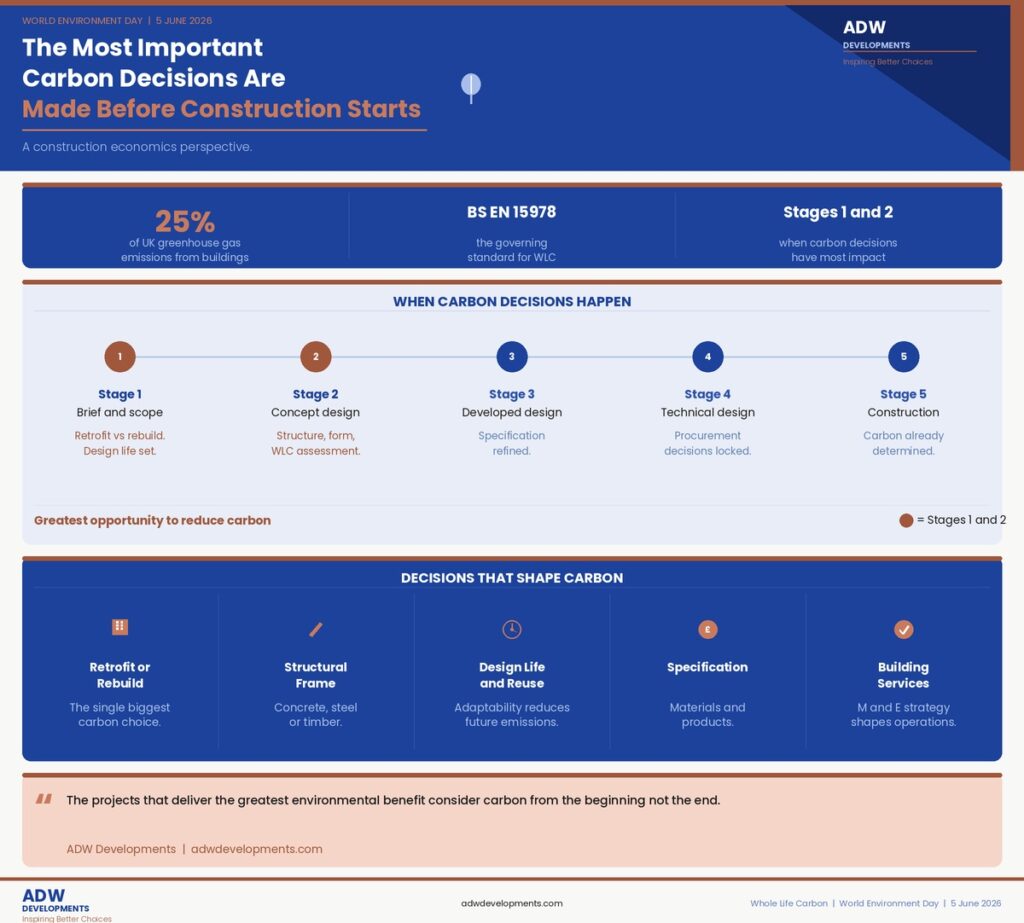
Before a single foundation is poured, project teams have already made choices that will shape a building’s environmental impact for decades. Retrofit or rebuild. Structural frame selection. Building form and massing. Material specification. Building services strategy. Design life and adaptability.
These decisions influence not only carbon emissions but capital cost, operational expenditure and long-term asset value. The earlier they are assessed, the greater the opportunity to improve outcomes across all of them.
Why Whole Life Carbon Changes the Picture
Whole Life Carbon assessment provides a framework for understanding the carbon consequences of design decisions across a building’s entire lifecycle. Rather than focusing solely on operational energy, it considers emissions associated with materials, construction, maintenance, replacement, and end-of-life scenarios.
The approach aligns with BS EN 15978 and the RICS WLC Assessment methodology, which has become the industry standard for carbon measurement in the UK built environment.
For project teams, the value lies in visibility. When carbon is measured alongside cost, teams can identify where emissions are concentrated and where reductions are commercially achievable. That is, before those decisions are locked into the design.
The Cost of Waiting
Too often, carbon assessments arrive after the key decisions have already been made.
At that point, the assessment can describe the environmental impact of the project. It cannot meaningfully change it.
Engaging early creates the opportunity to test options, compare alternatives and understand where the greatest carbon savings sit. In many cases, the most effective carbon reduction measures are also commercially sensible. Efficient structures, adaptable buildings, retained assets and durable materials frequently reduce future expenditure alongside emissions.
This is the point at which construction economics and environmental performance are most closely aligned, and it is the earliest stages of design where both disciplines have the greatest influence.
The Industry Is Moving
Whole life carbon is rapidly becoming part of mainstream project decision-making. Clients are increasingly looking for evidence that design choices support not only environmental objectives, but also long-term value, resilience, and future compliance. The earlier those decisions are understood, the more options remain available to influence outcomes.
Better Decisions Create Better Outcomes
World Environment Day is a useful moment to step back from the technical detail and ask a simpler question: at what point in the process do the most important environmental decisions actually get made?
The answer, consistently, is early. The projects that deliver the greatest environmental benefit are rarely those that focus on carbon at the end. They are the projects that consider it from the beginning, when the brief is still flexible, when structural options are still open, and when the cost of change is still manageable.
At ADW Developments, we help clients understand the long-term implications of design decisions through Whole Life Carbon Assessments, Life Cycle Costing, and sustainability consultancy. Not because reporting requires it, but because better decisions start with better evidence.