
Post-Occupancy Evaluation often starts long after the project team has moved on. A building achieves a strong BREEAM rating at post-construction stage. The certificate goes on the wall. Twelve months later, the facilities manager is dealing with complaints about overheating on the upper floors. Energy bills are significantly higher than forecast, and nobody is entirely sure why.
This is not necessarily a failure of design. More often, it is a failure of follow-through. And this does happen more often than you’d expect.
The Gap Nobody Talks About
Post-Occupancy Evaluation is not a new idea. We already explored what it is, how it works under BREEAM Man 05, and why it matters for building performance. What gets discussed far less often is what happens when POE data reaches the people who need it most. The investors, asset managers, and lenders who own or finance the building once the project team has moved on.
That conversation is changing quickly. Because operational performance is no longer just a sustainability issue, it is also a financial one.
What Investors Are Now Asking For
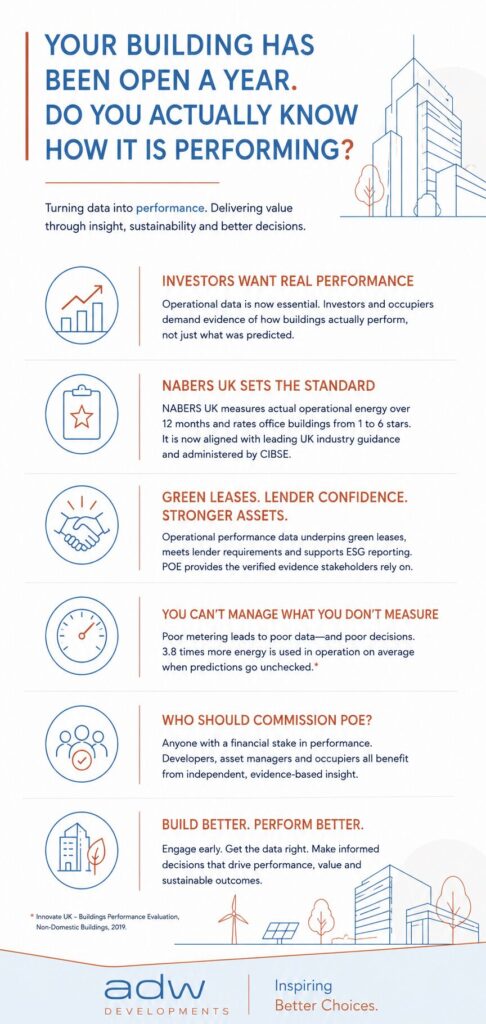
The commercial property market has shifted considerably in recent years. Investors and occupiers increasingly expect verified operational performance from high-quality buildings. A BREEAM certificate on its own is no longer enough to demonstrate that a building is genuinely performing well in use.
What funders and institutional investors want now is evidence of actual operational performance. Not what the model predicted, but what the meters say.
NABERS UK has become part of that conversation. Unlike design-stage modelling tools, it measures actual operational performance over 12 months using metered energy data. Office buildings are rated on a one to six star scale, with separate ratings available for the base building, whole building, and tenancy.
In April 2024, CIBSE became the administrator of the NABERS UK scheme, reflecting its growing role within the UK building services industry.
NABERS UK is also referenced across wider industry guidance, including the BCO Guide to Specification, the RIBA Plan of Work, UKGBC guidance, LETI Energy Use Intensity targets for offices, BSRIA Soft Landings, CIBSE TM54, and GLA energy policy guidance.
This matters for POE because the two are closely linked. A thorough post-occupancy evaluation provides the operational evidence needed to understand how a building is actually performing. Good metering, complete handover information, and properly collected year-one data all make operational benchmarking far more meaningful. Without that groundwork, neither a POE nor any operational rating system can provide a fully reliable picture of building performance.
Green Leases and Lender Covenants
Operational performance data is also becoming increasingly important within the financial structuring of commercial property.
Green leases, which include obligations around energy monitoring, data sharing, and minimum performance standards, are becoming standard across many institutional portfolios. Without a verified understanding of how a building performs in operation, those obligations become difficult to monitor and even harder to demonstrate.
Lenders are paying closer attention as well. Sustainability-linked loans and green finance frameworks increasingly require borrowers to demonstrate that assets are meeting operational performance commitments. A building with a strong post-construction BREEAM rating but no verified in-use performance data is becoming a far less comfortable position at refinancing stage.
This is where POE becomes commercially important. It provides a documented and evidence-based picture of how a building is actually performing in use. That information supports ESG reporting, helps asset managers understand operational risk, and gives investors greater confidence in long-term building performance.
The Metering Problem
This is where many projects run into trouble.
A post-occupancy evaluation is only as good as the data it can access. Research carried out through Innovate UK found that non-domestic buildings were, on average, using 3.8 times more energy than predicted at design stage.
That figure is not simply a reflection of design quality. In many cases, it reflects what happens when buildings are handed over without adequate sub-metering, without clear operational guidance for facilities managers, and without a structured commitment to monitoring performance in use.
Operational assessment frameworks depend heavily on reliable data collection. If the metering strategy was not considered properly during design and construction, meaningful verification becomes extremely difficult once the building is occupied.
The implication for developers and project teams is fairly straightforward. If a building is going to be evaluated in operation, whether through a BREEAM Man 05 POE or another operational performance framework, the groundwork needs to be established during RIBA Stage 3 or 4, not after the building opens.
Metering strategy, data management systems, commissioning records, and handover documentation all determine whether a year-one evaluation will provide meaningful insight or simply a collection of incomplete data.
Who Should Be Commissioning POE
The honest answer is simple: whoever has a financial stake in the building performing as intended should be commissioning POE.
For developers, it closes the feedback loop and provides evidence that the project’s performance targets are being reflected in operations. For asset managers, it helps benchmark performance across portfolios, identify underperforming assets, and prioritise investment decisions. As for occupiers, it links operational costs to actual building performance and supports the data-sharing obligations increasingly included in modern green leases.
Independence matters here as well. Under BREEAM Man 05, where the organisation carrying out the POE has also been involved in the original design, clear evidence of process independence must be demonstrated to the assessor.
In practice, appointing an independent consultant removes that ambiguity and often gives greater confidence in the findings.
The ADW Approach
ADW Developments carries out Post-Occupancy Evaluations as standalone commissions and as part of broader BREEAM Man 05 compliance programmes. We work with developers, asset managers, and building owners, not only with project teams.
Where possible, we engage from RIBA Stage 3 onwards to help ensure that metering strategies, commissioning information, and handover documentation will support a meaningful evaluation once the building is occupied.
If your building has already been occupied for more than a year and no evaluation has been carried out, the data is often still there. It simply needs the right framework to turn it into something useful. Contact us today to discuss how we can help.