
Ask three people what Life Cycle Costing (LCC) means and you will often get three different answers.
One may describe a high-level cost comparison completed at RIBA Stage 2 to inform structural or façade options. Another may refer to a detailed component-by-component assessment supporting procurement decisions. A third may describe a long-term financial model tracking operational, maintenance, replacement, and end-of-life costs across a 60-year period.
All three are valid applications of Life Cycle Costing. That flexibility is what makes LCC such a valuable discipline, but it is also what makes it easy to commission the wrong type of assessment at the wrong stage of a project.
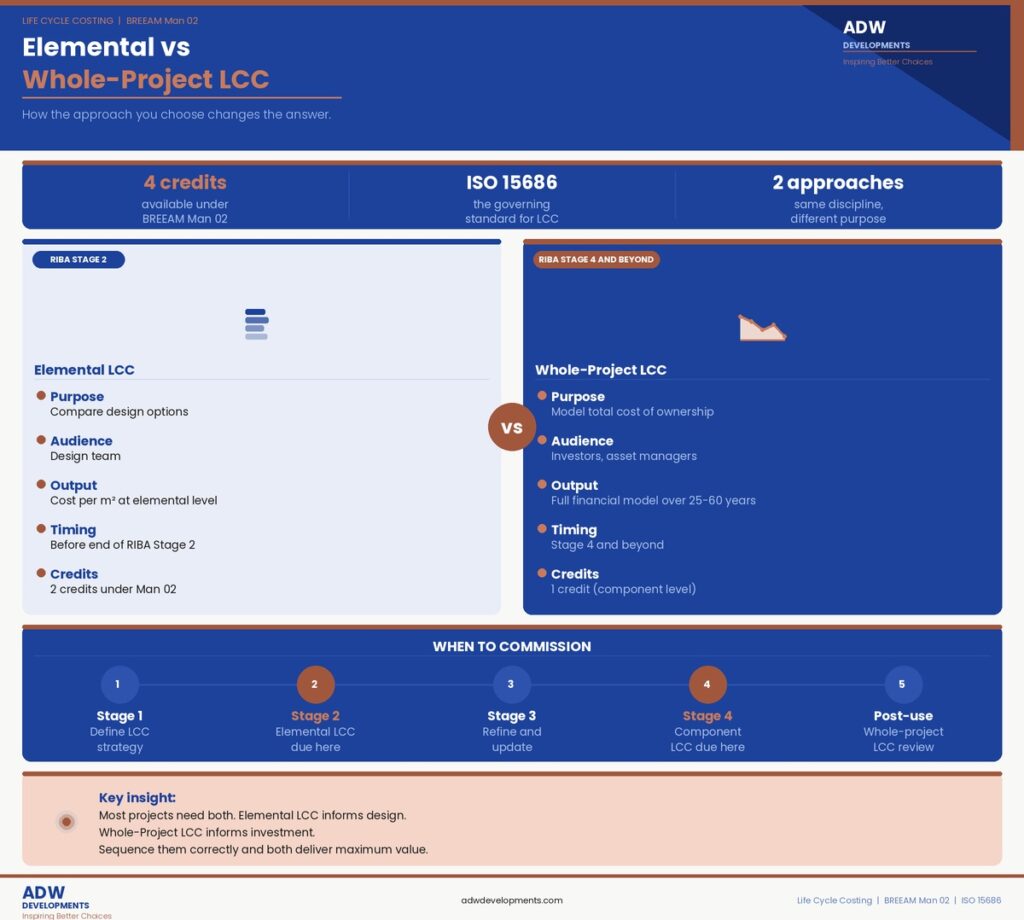
Not All LCC Is the Same
Life Cycle Costing estimates the total cost of an asset across its anticipated life, including acquisition, operation, maintenance, replacement, and disposal costs.
ADW carries out assessments in accordance with ISO 15686 Parts 1 and 5 and PD 156865, the UK published document supporting BS ISO 15686-5.
While the underlying methodology is consistent, the approach varies significantly depending on:
• the purpose of the assessment
• the RIBA stage
• the level of available design information
• the intended audience for the outputs
The two most common approaches on UK construction projects are Elemental LCC and Whole-Project LCC. These are not interchangeable, and selecting the appropriate approach at the correct stage is critical.
Elemental LCC: The Design Stage Tool
Elemental LCC is primarily used during early design development and options appraisal.
At this stage, assessments are typically based on elemental building costs, benchmark data, comparative modelling, and outline specifications rather than fully developed technical information.
This is also the approach most commonly associated with BREEAM compliance.
Under BREEAM UK New Construction 2018 Man 02, completing an Elemental LCC Plan by the end of RIBA Stage 2 can contribute towards achieving the available credits. The objective is not to create a definitive financial model, but to support informed design decisions before changes become costly or impractical.
Typical questions at this stage include:
- Does the structural frame deliver strong long-term value over the building lifecycle?
- How can the façade strategy reduce future maintenance and replacement costs?
- What MEP solution offers the most efficient balance of operational and maintenance expenditure?
The outputs are generally presented as elemental costs against gross internal floor area and are intended to compare options consistently rather than predict exact future expenditure.
Timing is critical. If the required assessment is not completed before the end of RIBA Stage 2, the relevant BREEAM credits cannot normally be achieved retrospectively.
Whole-Project LCC: The Investment Tool
Whole-Project LCC operates at a broader and more detailed level.
Rather than comparing design options, it evaluates the total cost of ownership of a completed asset across an agreed study period, commonly 25, 30, 50, or 60 years.
These models typically consider:
• operational expenditure
• planned maintenance
• replacement cycles
• end-of-life costs
• service life assumptions
• sensitivity and risk analysis
This is the type of assessment used by asset managers, institutional investors, portfolio owners, and lenders to understand long-term asset performance and financial exposure.
It also provides the commercial justification for many sustainable design decisions by demonstrating that higher upfront capital expenditure can reduce long-term operational and replacement costs.
A whole-life approach recognises that the lowest capital cost does not necessarily represent the best long-term value.
What BREEAM Man 02 Requires
Under BREEAM UK New Construction 2018, Man 02 Life Cycle Cost and Service Life Planning includes credits relating to:
• Elemental Life Cycle Costing
• Component Level Life Cycle Costing
• Service Life Planning
• Capital Cost Reporting
The Component Level LCC builds upon the Stage 2 elemental assessment and must typically be completed before the end of RIBA Stage 4.
Where the Elemental LCC compares high-level systems, the Component Level assessment compares specific products, specifications, and assemblies to determine which option delivers the best whole-life value.
Capital Cost Reporting requires the project capital cost to be submitted confidentially to BRE for industry benchmarking and research purposes.
LCC also aligns closely with Life Cycle Assessment (LCA) under Mat 01. Running LCC and LCA in parallel from Stage 2 onwards often creates the most efficient route to coordinated commercial and environmental decision-making.
Choosing the Right Approach
Most significant projects require both approaches, applied at different stages and for different purposes.
At RIBA Stage 2, Elemental LCC supports design development, option comparison, and BREEAM compliance.
At RIBA Stage 4, Component Level LCC refines those decisions through detailed specification comparisons.
Beyond completion, Whole-Project LCC supports investment analysis, portfolio management, lifecycle planning, and operational decision-making.
Confusing these different purposes is one of the most common mistakes in Life Cycle Costing.
A detailed whole-project model completed too early is expensive, highly assumption-driven, and likely to require substantial revision. Equally, a late-stage elemental assessment is unlikely to influence design outcomes or satisfy BREEAM requirements effectively.
The ADW Approach
ADW Developments provides both Elemental and Whole-Project Life Cycle Costing services.
Our Elemental assessments support early-stage decision-making, BREEAM compliance, and option appraisal. Our Whole-Project models evaluate long-term operational, maintenance, replacement, and ownership costs across individual assets or wider portfolios.
Where possible, we engage from RIBA Stage 1 onwards. Early involvement allows the assessment strategy to align with programme constraints, sustainability targets, investment objectives, and certification requirements from the outset.
The industry has established the methodology. The real value lies in applying the right approach at the right stage.
If your project is approaching RIBA Stage 2 on a BREEAM scheme, or you manage an asset without a formal whole-life cost assessment, ADW can help identify the most appropriate approach.
Timing matters. Teams must complete the required assessment before the end of RIBA Stage 2, as projects cannot usually recover the relevant BREEAM credits retrospectively. Contact us today to discuss your project.