
Security is worth a single credit in BREEAM, so it is easy to treat as an afterthought. That is exactly how it catches people out. Teams lose this credit often, and they lose it expensively, because they almost always underestimate two of its requirements.
The first is who does the work. The second is when they do it. Both are commercial decisions long before they become technical ones.
One quick note on the name. The security credit was Hea 06 in the BREEAM UK New Construction 2018 scheme, and in Version 7 it becomes Hea 08.
What the Credit Actually Requires
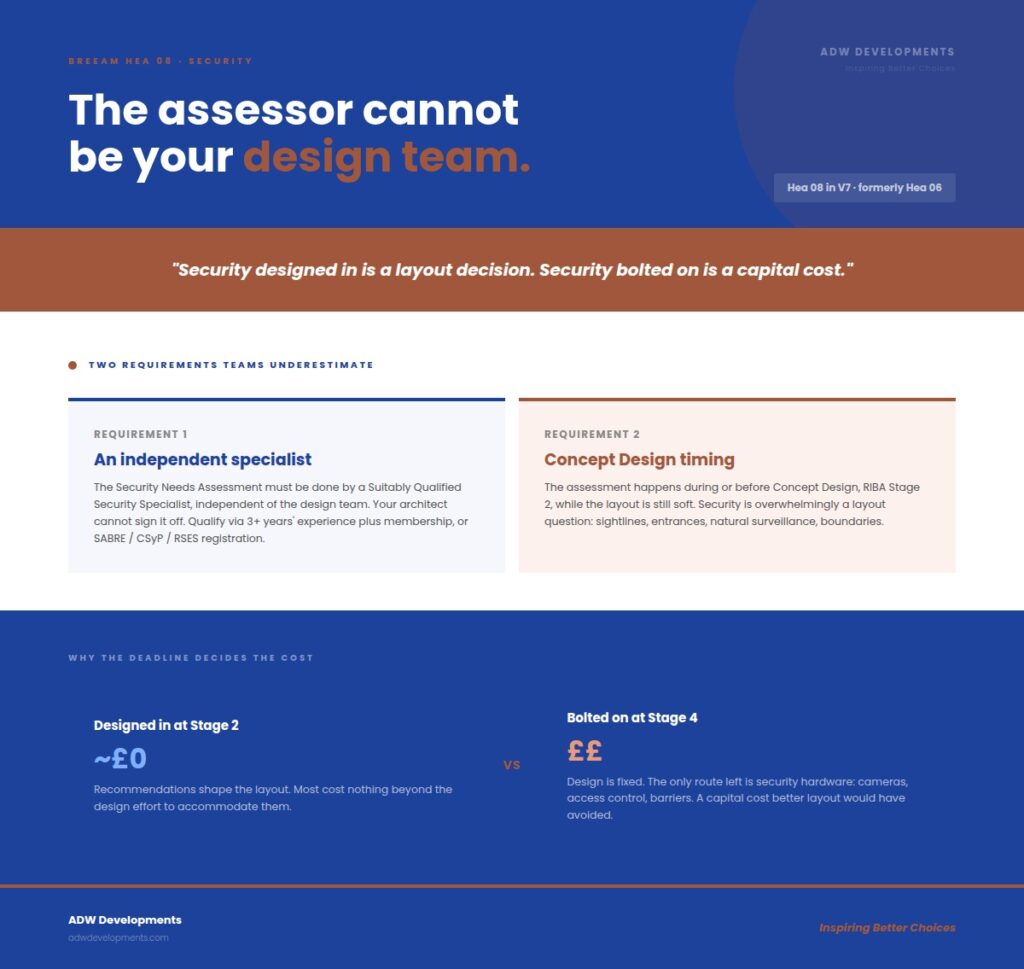
Hea 08 awards its credit for one thing: a Security Needs Assessment. A Suitably Qualified Security Specialist carries it out, and the team then builds their recommendations into the design.
The Security Needs Assessment is an evidence-based appraisal of the site and the building. It studies local crime data, audits the site and its surroundings, reviews the design proposals, and produces specific recommendations to reduce the risk and the fear of crime. The team then has to build those recommendations into the scheme, and justify any departure from them to the specialist.
| The credit is not awarded for producing a security report. It is awarded for a report that changed the building. Recommendations that are gathered and then ignored do not comply. |
The Specialist Cannot Be Anyone
A Suitably Qualified Security Specialist must carry out the Security Needs Assessment, and BREEAM defines that term precisely. It is not a role the architect or the M&E consultant can absorb.
An individual qualifies as an SQSS in one of two ways. Either they meet a set of experience and membership criteria, or they hold registration with a BREEAM-recognised scheme.
| Route | What it requires |
| A | A minimum of three years of relevant security experience within the last five years, demonstrating a practical understanding of security in the built environment, plus a qualification relevant to security, plus full membership of a relevant professional body with a code of conduct. |
| B | Registration with a BREEAM-recognised third-party scheme. Recognised routes include SABRE Registered Professionals with SQSS status, Chartered Security Professionals, and the Register of Security Engineers and Specialists. |
There is a further condition that matters commercially: the specialist should be independent of the design team. A Designing Out Crime Officer from the local police can contribute, and BREEAM encourages their input, but a qualified, independent specialist still has to carry out the assessment itself. This independence is the point. A security appraisal written by the people who produced the design is not a check on that design. It is a description of it.
| Independence is not bureaucratic friction. It is the reason the credit has value. An outside specialist sees the vulnerabilities the design team, close to its own decisions, has stopped noticing. |
Why Concept Design Is the Deadline That Matters
BREEAM expects the Security Needs Assessment to happen during, or before, Concept Design, RIBA Stage 2. That timing is not administrative. It is where the cost of the credit is decided.
Good security design is overwhelmingly about layout. Sightlines, natural surveillance, the position of entrances, the definition between public and private space, boundary treatments, and access routes. These are Concept Design decisions. Change them at Stage 2 and the cost is a redrawn plan. Change them at Stage 4 and the cost is structural.
A specialist brought in early shapes the layout while it is still soft, and most of their recommendations cost nothing beyond the design effort to accommodate them. A specialist brought in late inherits a fixed design, and the only remaining way to satisfy their recommendations is through bolt-on security equipment: cameras, access control, lighting, physical barriers. That hardware is a capital cost that early layout decisions would have reduced or removed.
| Designed in at Concept Design, security is mostly free. Bolted on at Technical Design, it is a bill for equipment that better layout would never have needed. The credit is the same. The cost is not. |
The Value Beyond the Credit
The single BREEAM credit understates what the assessment is worth.
A building with a documented, evidence-based security strategy is a different commercial proposition from one without. It is easier to insure, because the risk has been assessed and mitigated. It is more attractive to occupiers, for whom the safety of staff and assets is a genuine concern. It also lowers the risk of the expensive, disruptive security retrofits that so often follow an incident in a building that no one designed with security in mind.
There is a reputational dimension too. Designing out crime reduces not just the risk of crime but the fear of it, and that shapes how people use a building and how its neighbourhood regards it. That is difficult to price precisely, and real nonetheless.
Where This Leaves Project Teams
Hea 08 rewards two decisions, and both need making early. Appoint an independent, suitably qualified specialist, and appoint them by Concept Design. Neither is difficult. Both are easy to overlook, right up until the point where overlooking them gets expensive.
The teams that treat security as a Concept Design input earn the credit almost as a by-product of better layout. The teams that leave it as a document to produce near the end pay for the same credit twice: once in fees, and again in the equipment a fixed design forces on them.
ADW supports project teams on the security requirements of BREEAM, along with other services we provide. Contact us to discuss your project.