
Man 02 is one of the more straightforward credits in BREEAM to achieve. It is also one of the most frequently missed. The requirements are clear, the methodology is well established, and the evidence is not onerous. Project teams lose these credits regularly, and almost always for the same reason. The analysis begins too late.
Man 02, Life Cycle Cost and Service Life Planning, sits in the Management section. It rewards teams for understanding what a building costs across its life, not only what it costs to build. The credit exists because BRE identified a specific barrier. A lack of cost data on more sustainable design was holding back the take up of better solutions. Man 02 addresses that. It asks teams to do the analysis, and to share the capital cost data behind the wider business case.
What the credit asks for
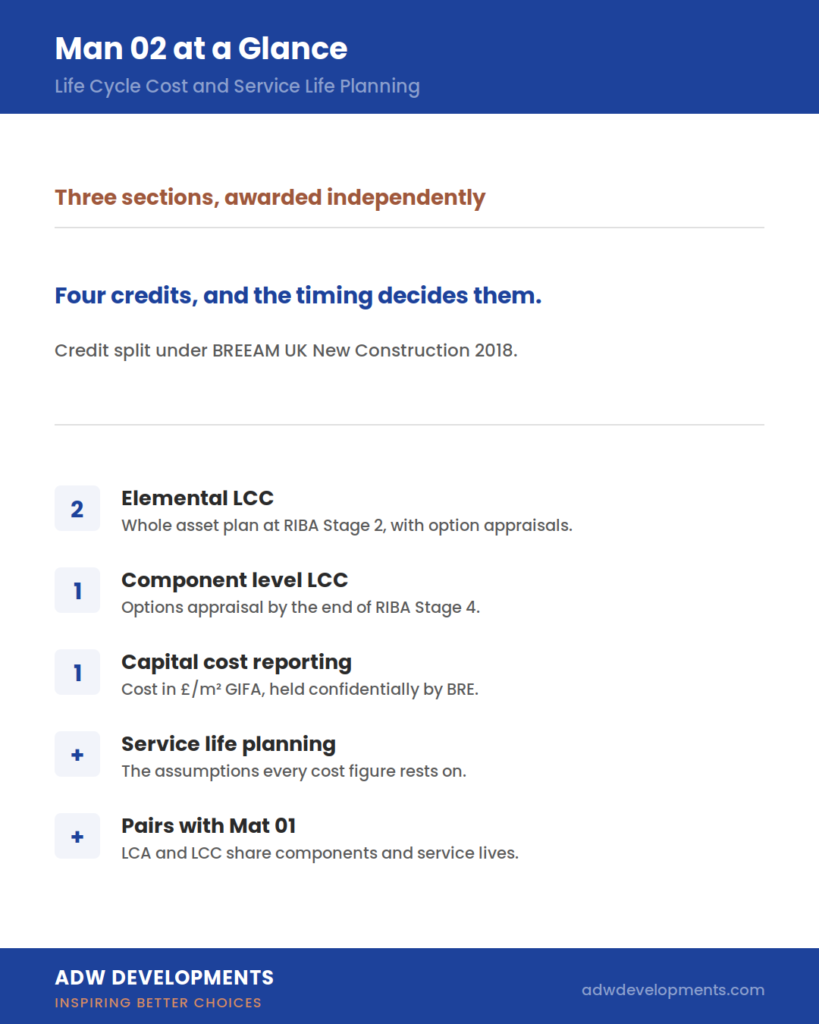
Man 02 divides into three separate sections, and each section earns its credits independently. A team can secure one and miss another.
The first is the elemental life cycle cost plan. Under the BREEAM UK New Construction 2018 scheme this carries two credits. It requires an outline, entire asset elemental LCC plan at RIBA Stage 2, concept design, with design option appraisals. The plan indicates future replacement costs over a period of analysis agreed with the client, commonly twenty, thirty, forty or sixty years. It also includes service life, maintenance and operational cost estimates.
The second is the component level life cycle cost options appraisal, worth one credit. The team develops it by the end of RIBA Stage 4. This moves from whole asset level down to specific components, testing the options that matter.
The third is capital cost reporting, also one credit. The team reports the building’s capital cost in pounds per square metre of gross internal floor area, through the BREEAM Assessment Scoring and Reporting tool. Gross internal floor area follows the RICS definition.
Both LCC sections follow recognised methodology. In the UK that is PD 156865, the standardised method of life cycle costing for construction procurement. Internationally it is ISO 15686-5, the life cycle costing part of the service life planning series.
Why the timing determines the credit
Read the elemental requirement again and the timing problem becomes obvious. The analysis has to happen at concept design, and it has to include design option appraisals.
An option appraisal compares alternatives. It only means something while alternatives still exist. At Stage 2 a team can still test a different structural approach, envelope or servicing strategy, and see how each performs over sixty years. By Stage 4 those choices have narrowed. By tender they have gone.
This is why teams lose Man 02 credits. Not because the analysis is difficult. Someone commissions it after the decisions it was meant to inform. A plan produced at Stage 4, against a requirement specifying Stage 2, does not comply however thorough it is.
There is a broader point here that reaches well beyond BREEAM. The value of life cycle costing comes from its influence on decisions. An analysis that arrives after the decision is a record, not a tool. BRE structured the credit this way precisely because it understood that.
Service life planning, the second half of the credit
The credit is called Life Cycle Cost and Service Life Planning. Most discussion concentrates on the first half.
Service life planning establishes how long a building and its components will last, and plans around that. It sits underneath the costing, because a life cycle cost model is only as sound as its service life assumptions. Assume a component lasts thirty years when it lasts eighteen. The replacement cost then lands twice in the period of analysis, not once. The whole comparison shifts.
This is why ISO 15686-5 sits inside the service life planning series rather than standing alone. The two disciplines connect formally. A team treating Man 02 as a costing exercise, without interrogating its service life assumptions, risks producing a model that will not hold.
The standards underpinning this work are also changing. The ISO 15686 series is being condensed. BS 8544, the British Standard for life cycle costing, is being broadened considerably. Teams setting briefs now should expect the methodological ground to shift over the next year.
Where Man 02 connects to the rest of the assessment
Man 02 rarely sits in isolation. Life cycle costing and life cycle assessment share assumptions: the same components, service lives and replacement cycles. A project already undertaking a building life cycle assessment for Mat 01 has done much of the underlying work.
Running the two together is more coherent and usually more efficient than running them separately. It also produces a better answer. The team sees cost and carbon consequences of one decision side by side, rather than two reports nobody reconciled.
Capital cost reporting, the third section, is the one most often skipped. It requires no modelling, only the reporting of a figure the team already holds. BRE keeps the data confidentially and does not disclose it, which addresses the commercial sensitivity that makes teams hesitate. The data feeds research into the cost of sustainable buildings, the barrier this credit exists to address. Declining to report it costs a credit and withholds information from the evidence base the whole industry relies on.
Getting It Right
Three things determine whether a project secures Man 02.
Commission the elemental analysis early enough to satisfy Stage 2, and early enough that the option appraisals compare real alternatives.
Agree the period of analysis and service life assumptions at the outset, with whoever holds the long term interest. Those assumptions drive every number that follows.
Treat the three sections as three separate opportunities. Teams that miss the elemental credits sometimes assume all is lost, and skip capital cost reporting too. It is awarded independently.
At ADW Developments, life cycle costing and elemental life cycle costing are core services. We work with project teams on Man 02 from concept design onwards. To discuss life cycle costing for a project you are planning, get in touch at enquiries@adwdevelopments.com.