
Overheating is usually discussed as a compliance question. Since 2021, Approved Document O has set requirements for limiting overheating risk in new residential buildings in England, and most teams treat it as a box to clear before planning.
That framing overlooks the financial consequence. The question is not only whether a scheme passes its overheating assessment, but what it must do in order to pass. A design that meets the threshold through passive measures and a design that meets it through mechanical cooling both comply. Their whole life costs and whole life carbon differ considerably.
Two things make this worth revisiting now. CIBSE has published TM59:2026, the first major revision of the residential overheating methodology since 2017, and it tests designs against warmer weather data than before. Approved Document O still references the 2017 version. For teams planning long lived assets, that gap is a cost question before it is a compliance one.
What passing actually costs
Where passive measures carry a scheme, the cost consequences are modest and mostly capital: orientation, glazing ratio, shading, openable area, thermal mass. These are design decisions rather than equipment, and once built they cost little to run.
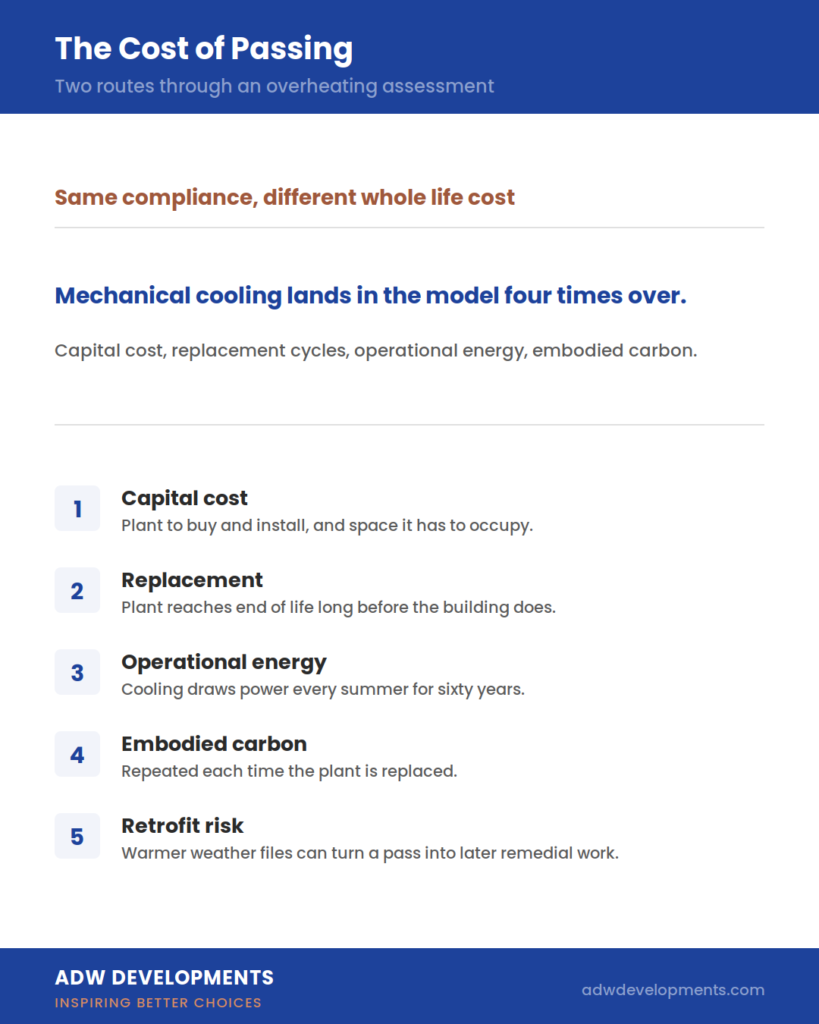
Where passive measures fall short, the fallback is mechanical cooling or mechanical ventilation. That changes the financial shape of the building. Plant carries capital cost, occupies space, and needs maintaining. It reaches the end of its service life long before the building does, so replacement lands inside the study period, sometimes more than once. And it draws energy every summer for the life of the asset.
This is exactly the territory life cycle costing exists to model. A life cycle cost analysis takes the capital cost, the maintenance regime, the replacement cycles and the operational energy, and expresses them as a single comparable figure. Set a passive scheme against a mechanically cooled one and the comparison stops being a matter of opinion.
The same decision moves the carbon
The carbon consequence runs in parallel, and it lands in the same place.
A whole life carbon assessment covers more than the emissions of construction. Its use stage accounts for operational energy and for the replacement of components during the building’s life. Mechanical cooling adds to both. The plant itself carries embodied carbon, which repeats each time it is replaced, and the electricity it draws adds operational carbon every year it runs.
So the overheating strategy is not only a comfort decision or a compliance decision. It moves cost and carbon together, in the same direction, through the same mechanism. That is unusual and useful. On many decisions, the low carbon option and the low cost option pull against each other. Here, a design that stays comfortable passively is generally better on both.
Why TM59:2026 changes the numbers
The revised methodology matters because it changes what a design has to survive.
CIBSE calls TM59 the industry blueprint for assessing overheating risk in new dwellings and major refurbishments. The 2026 edition is the first substantial revision since 2017, and three changes bear on cost.
TM59:2026 mandates new Design Summer Year files reflecting the latest UK climate projections. Assessments now test designs against warmer future summers rather than historic ones. A scheme that passes comfortably on 2017 weather data may sit close to the line on 2026 data.
The bedroom criterion has changed. A night time mean temperature limit replaces the previous hourly threshold, drawing on recent sleep research.
Ceiling fans now count. The methodology allows temperature threshold uplifts where ceiling fans form part of the base build or a major retrofit. That opens a low energy route the earlier version did not recognise, and one that is considerably cheaper to install, run and replace than mechanical cooling.
CIBSE has confirmed that TM59:2017 remains the version required for Part O compliance. It recommends TM59:2026 to align with industry best practice, and has said it is in active discussion with the Building Safety Regulator about how the updated weather files and the latest TM59 might enter the Approved Documents.
The Cost of a design that only just complies
Here is the practical consequence for anyone holding a long term interest in a building.
A scheme designed to pass the current requirement, on historic weather files, may not stay comfortable through the summers it will actually meet. The building stands for sixty years. The weather data used to assess it does not.
When that gap shows up in use, the remedy is retrofit cooling. Retrofitting plant into an occupied residential building is expensive, disruptive, and constrained by spaces never designed to hold it. It also arrives as an unbudgeted cost, because nobody modelled it at design stage.
That is a whole life cost risk created by a compliance decision. It does not appear in a capital cost plan, and it does not appear in an assessment run against 2017 weather files. It appears years later, as an unbudgeted item on an operational cost plan.
Testing a design against both TM59:2017 and TM59:2026 makes the risk visible while it can still be designed out. The first tells you whether the scheme complies today. The second tells you whether it will still perform once the regulation catches up and the summers arrive.
Early enough to matter
The decisions that determine overheating risk are made early: orientation, glazing ratio, façade design, floor to ceiling heights, thermal mass, the ventilation strategy, and whether the scheme can rely on openable windows in a noisy or insecure location. By the time a modeller can run a full TM59 assessment, most of these are settled.
That is also when the cost and carbon consequences are cheapest to change. Comparative modelling at concept stage can show whether a passive strategy will hold on a constrained urban site, or whether the scheme is heading towards mechanical cooling and the whole life costs that come with it. Knowing that early changes what gets designed. Knowing it at planning stage only changes what gets reported.
Two things worth doing
For schemes at design stage, two steps are straightforward and useful.
Test against both editions of TM59, not just the one compliance requires. The difference between the results is a measure of how much climate risk the design is carrying.
Model the cost and carbon of the compliance route, not just the pass or fail. Where a scheme needs mechanical cooling to comply, that should enter the life cycle cost model and the whole life carbon assessment as capital cost, replacement cycles, operational energy and embodied carbon, rather than sitting outside them as a technical solution.
At ADW Developments, life cycle costing, whole life carbon and climate change adaptation sit within our services. To discuss how an overheating strategy could affect the whole life cost and carbon of a scheme you are planning, get in touch at enquiries@adwdevelopments.com.