
A BREEAM In-Use condition survey is the evidence the Rsc 01 credit depends on. BREEAM In-Use assesses buildings that are already operating. It looks at how an asset performs and how its owner manages it. Design intent is not the measure. Rsc 01 sits in the Resources section, and it asks for a survey of the building’s physical condition.
An asset manager who does not know the physical condition of a building cannot plan maintenance properly. Work gets done reactively, components fail earlier than they should, and repairs cost more than they needed to. Rsc 01 sets out to give asset management a complete understanding of the physical condition of the property. Maintenance can then run to a schedule, and the risk of early obsolescence or costly future repairs reduces.
A survey carried out to satisfy Rsc 01 therefore has to do more than record defects. It has to produce information an asset manager can act on.
What The Survey Has To Cover
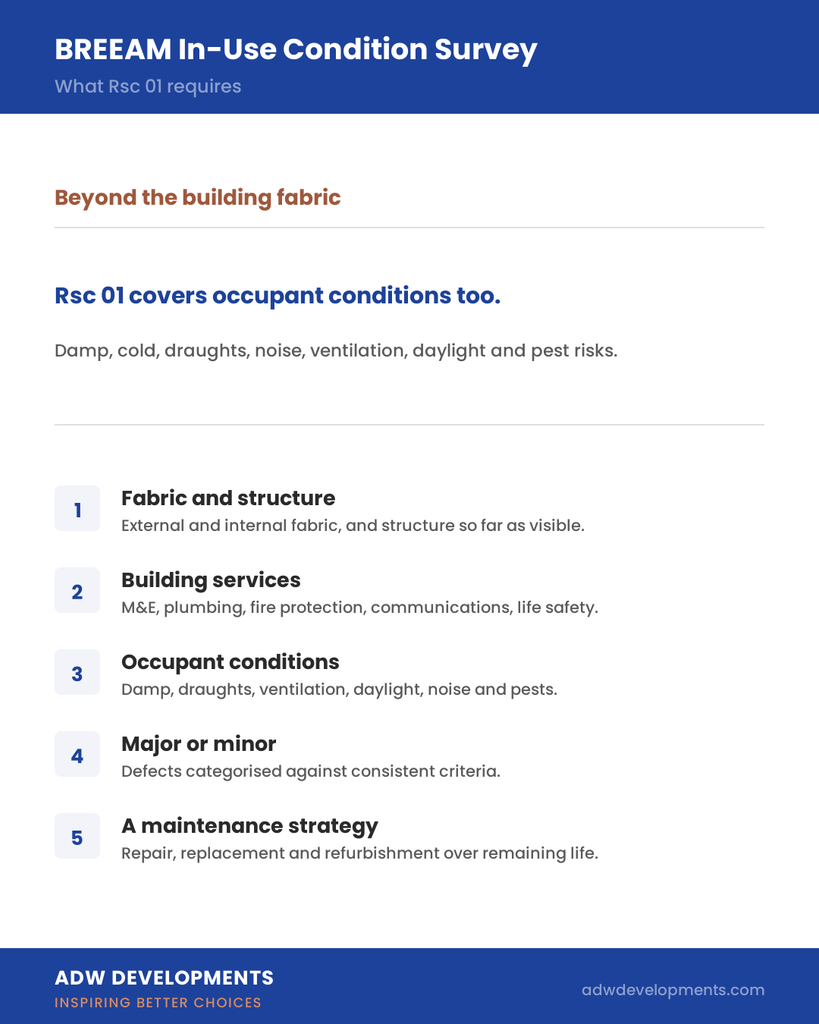
The survey assesses the main building elements, components and construction products.
That means the external and internal fabric, including walls, windows, doors and finishes. It means the structure, so far as it can be seen. It means the building services, covering mechanical and electrical components, plumbing, fire protection, communications and life safety systems.
Rsc 01 also asks for something that a conventional building survey often leaves out. The survey has to evaluate the environmental conditions affecting the people using the building. These cover damp, cold, draughts, acoustic and noise penetration, ventilation effectiveness, daylight availability and pest risks.
These are occupant wellbeing issues as much as building fabric issues, and they rarely appear in a standard condition report. A surveyor who arrives with a conventional template will record the fabric accurately and miss this group entirely. The template matters as much as the inspection.
Non–intrusive Inspection
Rsc 01 is satisfied by non-intrusive physical inspection. The surveyor records what can be established without opening up the building, taking samples or carrying out destructive testing.
This is the appropriate scope for the credit and it suits an operating asset. A hotel, an office or a retail unit cannot usually accommodate intrusive investigation without disrupting the people using it.
It also sets a clear boundary on what the survey can report. Where a risk sits behind a finish or inside a construction, a non-intrusive survey can identify the possibility and recommend further investigation. It cannot confirm the condition. A report that records this honestly is more useful than one that implies a certainty it cannot support.
Categorising Defects
A list of defects is of limited use unless the reader can tell which ones matter.
Rsc 01 work therefore needs clear criteria for repair and renewal, applied consistently. Defects are categorised as major or minor. A major defect adversely affects the function or operation of the asset. A minor defect is cosmetic, or a problem that may develop in future but does not currently affect how the building works.
Consistency matters more than the labels themselves. Several buildings often mean several surveyors. A shared definition of major and minor lets an asset manager compare one building against another and decide where to spend first. Without it, the categorisation reflects the judgement of whoever carried out each survey.
Recommendations, Not Just Findings
The survey report has to set out what should happen next.
That covers planned preventative maintenance, repair, replacement and refurbishment, scheduled across the remaining life of the assets. The output should be a maintenance strategy an asset manager can budget against, rather than a record of the building’s current faults.
Replacement timings drawn from observed condition behave differently from timings drawn from published averages. That difference carries through into life cycle cost models and long term expenditure planning.
Independence And The Credit Level
Rsc 01 recognises who carried out the survey, not only what it found.
The highest credit level requires assessment by an independent, competent third party. An owner’s own facilities team may know the building better than anyone. Their assessment still carries less weight in the certification, because they report on an asset they maintain.
An owner pursuing the full credit therefore appoints surveyors independent of the asset. They also have to be competent to carry out the work. RICS-certified building surveyors are the usual route.
Consistency Across A Portfolio
Most BREEAM In-Use certification covers more than one asset. Surveys commissioned building by building create a problem at portfolio level.
Different surveyors in different locations produce different reports. The headings vary. The defect thresholds vary. The level of detail varies. The result is a set of documents that each describe a building accurately and cannot be read against each other.
A standardised survey template, built around the evidential requirements of the credit and applied across every asset, solves this before it arises. Centralised technical review of the completed surveys does the rest. Local surveyors provide knowledge of the area and access to site, while the template and the technical review provide comparability and compliance.
Rsc 03 Sits Alongside It
Rsc 03 Resources Inventory covers related ground and is usually worth gathering at the same time.
Where Rsc 01 asks about condition, Rsc 03 treats the building as a materials bank. It calls for a structured schedule of each significant resource. Resources are classified by function, such as floor finishes or windows, and by constituent material, such as mineral wool or mild steel. The Uniclass classification system is the usual basis.
An extended inventory goes further. It covers the indicative financial value of the resources identified, and guidance on retaining that value through planned maintenance and repair. It also covers end of life planning, so that material value survives future disassembly or demolition. Circular economy principles under BS 8001:2017 inform this work.
The data for both credits can be collected on the same site visit. Surveying twice costs more and disrupts occupants twice.
What This Means For An Owner
Rsc 01 is not only a certification requirement. A survey scoped properly produces the maintenance programme, the budget and the replacement timings an asset manager needs regardless of BREEAM. The credit follows from doing that work well.
A survey scoped poorly produces a document that satisfies nobody. It records defects without categorising them. It covers fabric without covering occupant conditions. It cannot be read against the other buildings in the portfolio.
ADW Developments provides condition surveys and resources inventories for BREEAM In-Use, covering single assets and portfolios. This work sits alongside our life cycle costing and elemental life cycle costing services. If you are working towards BREEAM In-Use certification and would like to discuss Rsc 01 or Rsc 03, contact us at enquiries@adwdevelopments.com.