
BS 8544 and the ISO 15686 series are familiar tools for life cycle costing and durability. Teams use them on projects every week. Both are now being rewritten, and the changes are substantial. They are likely to influence good practice from 2027 onwards. If you are working to the current versions, it is worth understanding what is changing now.
ADW Developments has a direct view of that process. Our Director Anthony Waterman represents the UK on B/558, Sustainability of Construction Works, Construction Works, which contributes to international sustainability standards through ISO and CEN committees. He also sits on CB/101, Service Life Planning, the committee responsible for the BS ISO 15686 series in the UK, and on CB/101/4, the working group revising BS 8544.
This article is not a primer on what these standards say. It is a briefing on what is changing and why it matters now. It also sets out what to do before the revised versions land.
BS 8544: from maintenance guide to whole life code of practice
The BS 8544 most practitioners have used is narrower than its reputation suggests. It was published on 30 September 2013. Its full title is Guide for life cycle costing of maintenance during the in use phases of buildings. It established rules and methodology for the life cycle costing of maintenance. It also gave guidance on capturing asset information and on prioritising maintenance works. Useful, but partial. It never claimed to cover the full financial life of an asset. It sat as a supplementary guide to BS ISO 15686-5, not as a standalone whole life code.
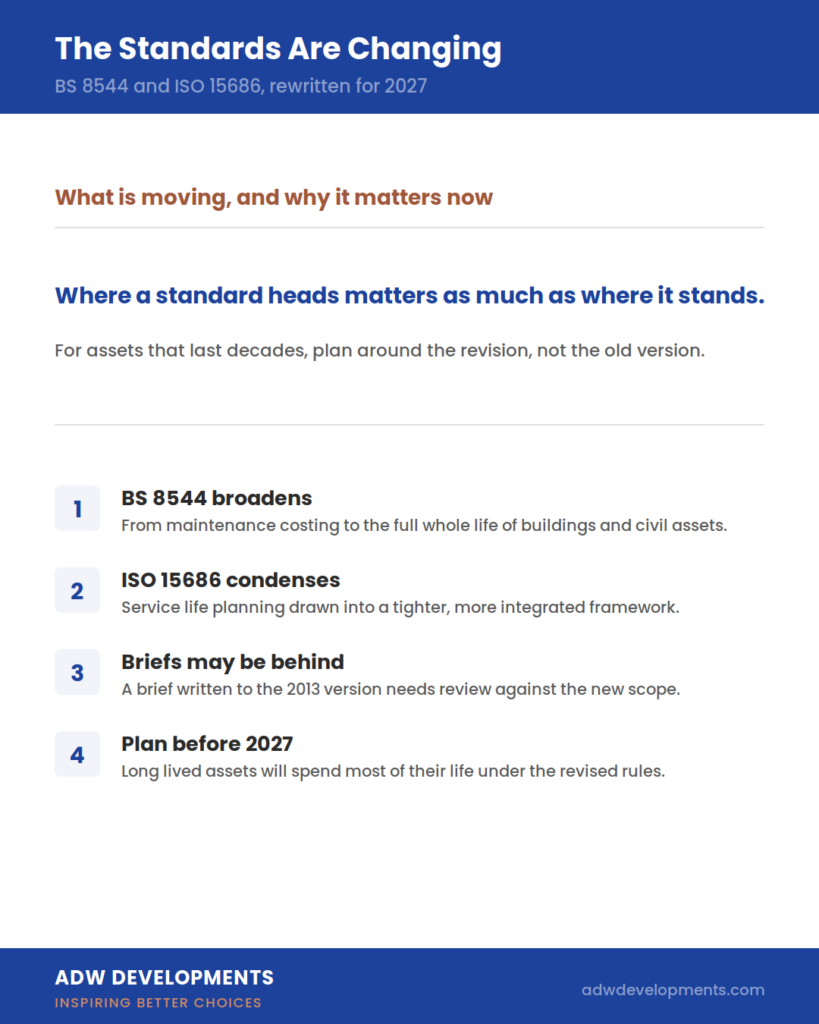
The revision underway changes that substantially. The revised standard carries a new title: Life-cycle costing of buildings and constructed assets, code of practice. Its scope reaches across acquisition, construction, renewal, operation and occupancy, maintenance, and end of life costs. Two changes stand out.
First, the revised standard extends to include operation and occupancy costs, which the 2013 version excluded. For anyone building a life cycle cost model, that widens what a compliant analysis must cover.
Second, it extends beyond buildings to infrastructure and other constructed assets. This gives the standard a broader scope across buildings and construction and infrastructure assets.
The revision also gives recommendations on how life cycle costing information should pass to clients. It includes requirements around identifying information as an organisational, asset, or project information requirement. That reflects a wider industry shift towards a continuous spine of asset data running from design and construction into operation.
The public consultation on the draft closed on 22 August 2026. BSI currently schedules publication for 15 December 2026. The timetable remains subject to the standards development process.
First, the revised standard extends to include operation and occupancy costs, which the 2013 version excluded. For anyone building a life cycle cost model, that widens what a compliant analysis must cover.
ISO 15686: seven parts becoming three
The ISO 15686 series is the international framework for service life planning. ISO technical committee TC 59, subcommittee SC 14, develops it.
The series is undergoing a more dramatic change than BS 8544. Rather than a straightforward update, the revision condenses the framework substantially. The draft Part 3 is titled Buildings and civil engineering works: Service life planning, Methods, data and communication. It sits at enquiry stage among ISO members. Once published, it and its companion parts replace seven existing documents: Parts 1, 2, 3, 4, 8, 9 and 10. Seven parts are becoming three.
The current Part 1 dates from 2011. It already carries the status of an International Standard to be revised, with replacement expected in the coming months.
Two details in this revision matter beyond the tidying up. The series title is shifting from Buildings and constructed assets to Buildings and civil engineering works. That mirrors the broadening of scope visible in BS 8544. The revised Part 3 also frames service life planning across the full life cycle. That runs from initiation, project definition and design, through construction, commissioning, operation and maintenance, to refurbishment, replacement, deconstruction and final disposal, recycling or reuse.
That framing is significant. It treats service life planning as a discipline running the length of an asset’s life, not a durability calculation performed once. At every stage it connects to cost, carbon and reuse. Part 5 remains the life cycle costing part. It is where service life planning and cost analysis formally meet.
Why the direction matters more than the current wording
Here is the practical consequence. A standard tells you what to do today. The direction of its revision tells you what the framework may look like tomorrow. For a decision that shapes an asset for decades, the second is often the more valuable of the two.
Consider a client setting a life cycle costing brief now. The scheme completes in two or three years and then operates for sixty. Written to the 2013 BS 8544, that brief covers maintenance in the in use phase. Written with the revision in view, it can anticipate the broader scope of the revised code. That means acquisition through to end of life, including operation and occupancy costs. It can also anticipate defined expectations about how the resulting data passes to the client. The first brief is not wrong today. It is simply narrower than the scope of the revised standard.
The same applies to service life planning. An analysis based on a part of ISO 15686 that is later withdrawn may need revisiting. One built around the consolidated framework may reduce the need for that review.
The cost of aligning early is small, usually a conversation at brief stage. The cost of retrofitting a decision to a standard that moved underneath it is considerably higher.
What to do before 2027
Three practical steps follow.
First, review any life cycle costing brief or appointment written to the 2013 BS 8544. Check its scope against the broader code now being developed. Briefs limited to maintenance costing are the ones most likely to need widening.
Second, where a decision depends on service life assumptions, check which part of ISO 15686 those assumptions rest on. Several parts are being replaced within the new three-part framework. An assumption based on Part 8 or Part 10 may need to be reviewed once the consolidated parts are published.
Third, on long-lived or high-value assets, consider the direction of the standards when setting the brief. Building the analysis around the emerging framework now may reduce the need to revisit key assumptions later.
None of this requires waiting for publication. Both revisions are public, and their direction is clear enough to inform planning now.
At ADW Developments, life cycle costing and durability sit at the centre of our work. To discuss how the coming changes could affect a project you are planning, get in touch at enquiries@adwdevelopments.com.