
BREEAM Version 7 renumbered the material efficiency credit. What project teams knew as Mat 06 is now BREEAM Mat 05, and BRE streamlined the assessment process along the way.
None of that is the interesting part.
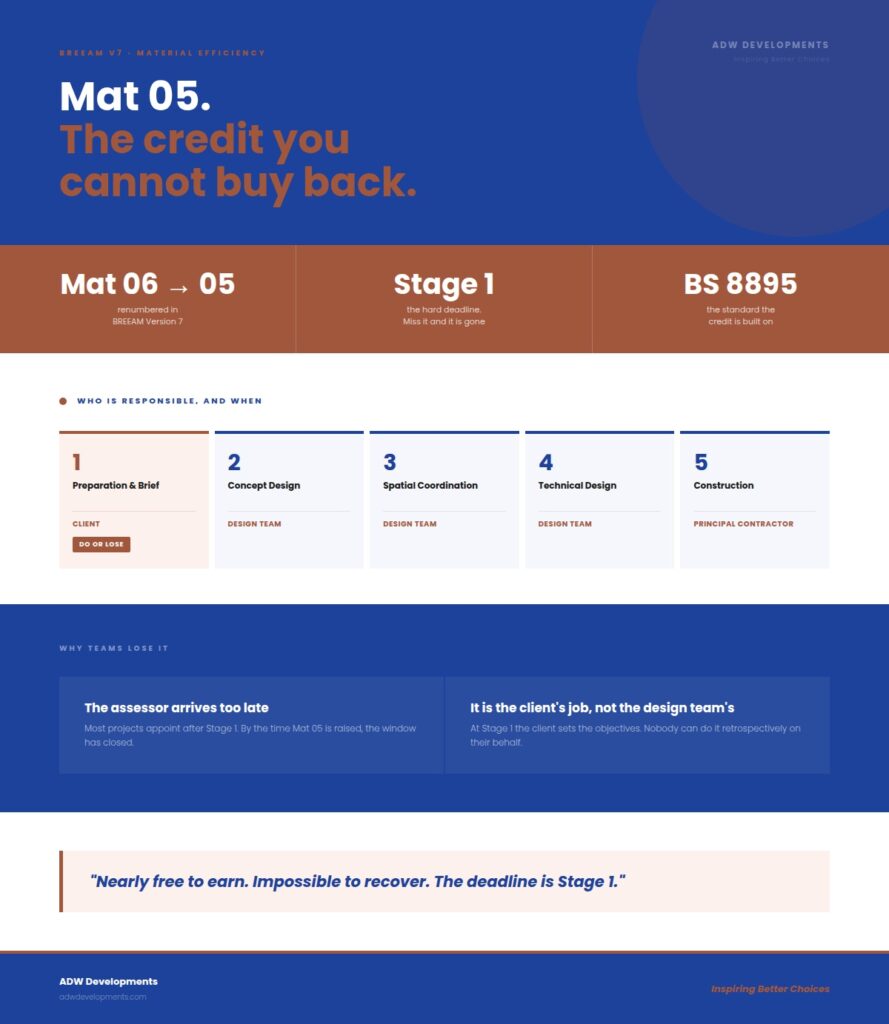
BREEAM Mat 05 behaves differently from almost every other credit in the scheme. Most credits stay available well into a project. If a team decides at Stage 3 that it needs one more credit to reach Excellent, options usually remain. Mat 05 does not work that way. If the project recorded nothing at RIBA Stage 1, the credit is unavailable. No budget, no consultant and no volume of retrospective paperwork will recover it.
What BREEAM Mat 05 Requires
Mat 05 rewards projects that optimise material use and reduce waste across the building lifecycle. It sits within the Materials category and asks a straightforward question: did this project actively try to use less material, and can it prove it?
The credit follows the principles set out in the BS 8895 series, Designing for Material Efficiency in Building Projects. BREEAM asks the project team to compile a material efficiency strategy and to keep developing it through the project. The strategy needs to identify targets and opportunities to optimise material use at RIBA Stages 1, 2, 3, 4 and 5.
The measures BREEAM expects teams to consider are practical. They include using fewer materials, reusing demolition or strip-out materials, considering recycled and reused materials where appropriate, standardising components to reduce cutting waste, optimising the structural design so it does less work with less material, using off-site prefabrication, and designing for disassembly, so the building gives its materials back at the end of life.
The Stage 1 Problem
BREEAM requires evidence of material efficiency thinking from RIBA Stage 1, Preparation and Brief. The evidence does not need to be elaborate. A documented workshop and a short strategy setting out objectives, targets, constraints and responsibilities will satisfy it. But something has to exist, and it has to exist from the beginning.
Two things make this a genuine commercial risk.
First, most projects appoint their BREEAM assessor after Stage 1. By the time anyone raises Mat 05, the window has closed.
Second, and less well understood, the Stage 1 responsibility does not sit with the design team or the contractor. It sits with the client or the client’s agent. BREEAM expects the client to assess the site, consider the likely scale of the project and their own functional requirements, and set the material efficiency objectives that guide everything downstream. Nobody can do this retrospectively on the client’s behalf.
Most teams discover this at Stage 3, when it is already too late.
What the Strategy Contains at Each Stage
The strategy is a living document. It develops as the design develops, with each stage reporting on progress and on any deviation from what came before.
| RIBA Stage | Responsible | What BREEAM expects |
|---|---|---|
| 1 Preparation and Brief | Client or client’s agent | Set objectives, performance indicators, opportunities, constraints and responsibilities. Evidence is typically workshop minutes and a short strategy document. |
| 2 Concept Design | Design team | Identify specific opportunities in the emerging design. Report on how the Stage 1 objectives are being applied. |
| 3 Spatial Coordination | Design team | Develop the proposals. Report deviations and additional actions. Evidence includes drawings and specifications showing the measures. |
| 4 Technical Design | Design team | Confirm how the measures carry into the technical package and the specification issued for tender. |
| 5 Construction | Principal contractor | Implement on site. Report deviations. Evidence includes meeting minutes, training events and waste reduction records. |
Assessors generally expect a table of considerations recorded at each stage against work packages, supported by a short report from whoever was responsible. Drawings, specifications and meeting minutes back it up where they show the thinking actually influenced the design.
What Changed in Version 7
The renumbering is administrative. Teams working from older documentation should update their references, but nothing fundamental about the credit’s intent has shifted. BRE has streamlined the assessment process, which makes the credit clearer to evidence than it was under Version 6.
What matters more is the company Mat 05 now keeps. Version 7 rewrote Mat 01 to require life cycle assessment at concept, technical and as built stages. It revised Wst 06 to align with ISO 20887 on design for disassembly. It updated Wst 01 with new criteria covering pre demolition audits and diversion from landfill. Material efficiency now runs through several credits at once, and the evidence overlaps.
A project that starts a material efficiency strategy at Stage 1 is already generating the thinking that Mat 01, Wst 01, and Wst 06 will ask for later. A project that skips it starts every one of those credits from a standing position.
The Construction Economics of a Single Credit
Mat 05 is a modest credit. On its own it will not transform a rating. So why does it deserve attention?
Because of what it costs, and what it costs to replace.
Achieved from Stage 1, Mat 05 is close to free. A workshop, a short strategy document, and the discipline of recording decisions the team should be making anyway. No specialist software, no expensive modelling, no material premium. The thinking it demands, using less material and wasting less of it, tends to reduce cost rather than add it.
Lost at Stage 1, it becomes expensive in a different way. The project still needs its target rating, which means finding the credit elsewhere. The cheap credits are usually the ones already claimed. Replacements tend to sit in energy, water or materials specification, where they carry real capital cost. A team that loses a free credit at Stage 1 often pays for it several times over at Stage 4.
Where This Leaves Project Teams
Mat 05 rewards a habit, not a purchase. The step itself is small: put material efficiency on the agenda at the first design workshop, record what is agreed, and name who owns it.
The harder question is who is watching for it. BREEAM assessors certify what a project has done. They are rarely appointed early enough to shape what it does. That gap is where credits like Mat 05 quietly disappear.
ADW works on the strategy side of that line. We deliver Mat 05 alongside the Mat 01 life cycle assessment, the Wst 01 pre-demolition audit and the Man 02 life cycle costing that share its evidence base. Coordinated from Stage 1, they reinforce one another. Commissioned late, each one starts from nothing.
The requirement is not what costs money. The timing is.
| ADW Developments provides BREEAM Mat 05 Material Efficiency assessments, working with project teams from RIBA Stage 1 through to construction. We also deliver the Mat 01, Wst 01 and Pre-Demolition Audit work that shares the same evidence base. To discuss your project, contact us here. |