
A building designed in 2026 will exist for years to come. It will spend most of its life in a climate that does not exist yet.
BREEAM Wst 05, Adaptation to Climate Change, asks project teams to take that seriously. It is worth one credit, with an exemplary credit available on top. It is also one of the few credits where BREEAM’s own guidance openly warns what happens if you leave it too late.
BREEAM Wst 05, Adaptation to Climate Change, asks project teams to take that seriously. It is worth one credit, with an exemplary credit available on top. It is also one of the few credits where BREEAM’s own guidance openly warns what happens if you leave it too late.
What BREEAM Wst 05 Actually Covers
This is where most teams go wrong before they start.
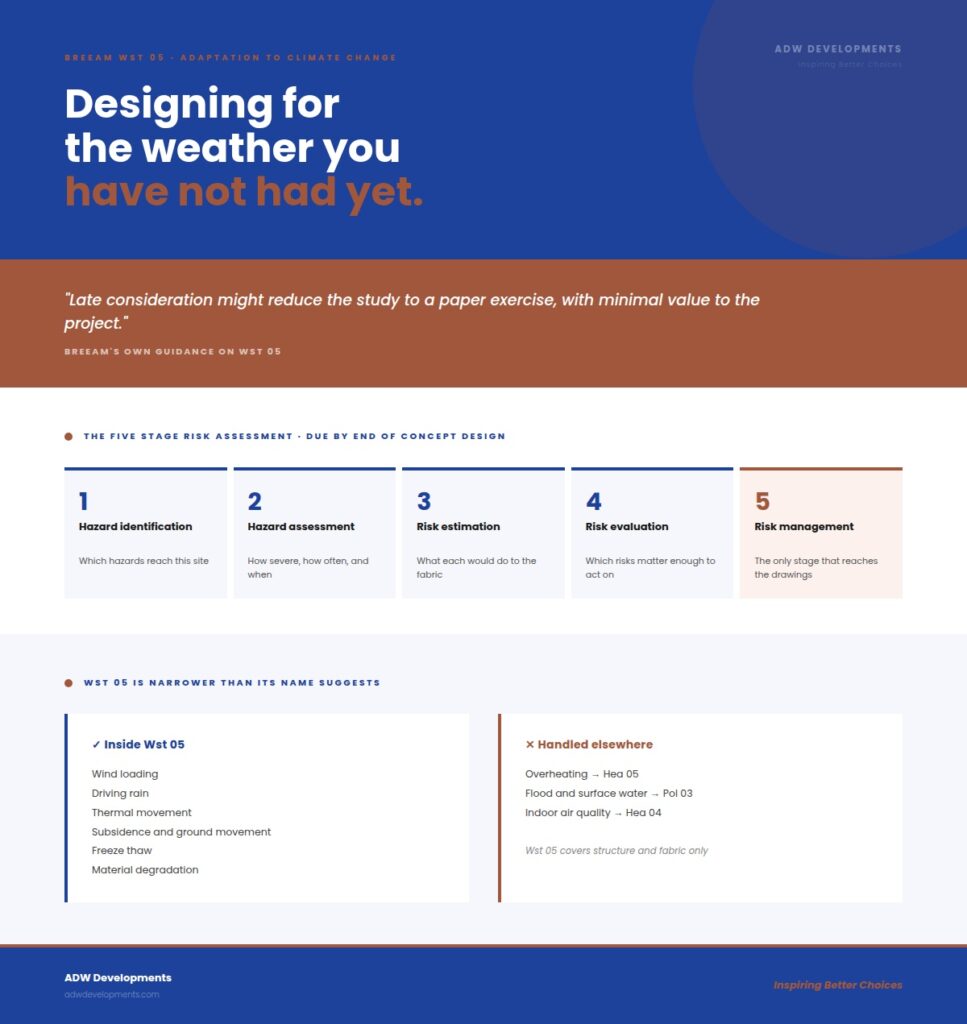
BREEAM Wst 05 is not the overheating credit. It is not the flood risk credit. Its scope is narrower and more specific than the name suggests. The main credit deals with structural and fabric resilience, and only structural and fabric resilience. Climate risks that other credits already handle sit outside it.
| Climate risk | Where it actually sits in BREEAM |
| Structure and fabric resilience | Wst 05. Wind loading, driving rain, thermal movement, subsidence, freeze thaw, material degradation. |
| Overheating and thermal comfort | Hea 05 Thermal comfort, not Wst 05. |
| Flood and surface water | Pol 03 Flood and surface water management, not Wst 05. |
| Indoor air quality | Hea 04 Indoor air quality, not Wst 05. |
Teams that submit a Wst 05 appraisal padded with overheating modelling and flood zone maps have not answered the question BREEAM asked. The credit wants to know whether the structure and the envelope will still be doing their job in sixty years, under conditions the design was not originally drawn for.
| The exemplary credit rewards the opposite instinct. It is awarded where a project demonstrates a holistic approach, evidenced by achieving related credits elsewhere in the scheme. Wst 05 is narrow. The exemplary credit is not. |
The Five Stage Risk Assessment
BREEAM does not ask for an opinion on climate risk. It asks for a systematic risk assessment, structured in five defined stages, informed by recognised climate projections.
| Stage | What it does | In practice |
| 1 | Hazard identification | Which climate hazards could reach this building on this site. Wind, rain, heat, drought, freeze thaw, ground movement. |
| 2 | Hazard assessment | How severe, how frequent, and how that changes across the projected life of the building. |
| 3 | Risk estimation | What each hazard would actually do to the structure and the fabric if it occurred. |
| 4 | Risk evaluation | Which risks matter enough to act on, and which the project can reasonably accept. |
| 5 | Risk management | What the design does about the risks that matter. This is the part that has to reach the drawings. |
Version 7 tightened the language around which projections are acceptable, requiring clearer reference to current climate science and aligning the credit with EU Taxonomy reporting. In the UK, that means the appraisal should draw on recognised national climate projections rather than general assumptions about a warming climate.
The Deadline That Decides Whether It Is Worth Doing
BREEAM requires the climate change adaptation strategy appraisal to be complete by the end of Concept Design, RIBA Stage 2. The recommendations then work their way into the design through Stages 3 and 4.
The logic is not administrative. It is structural, in both senses. Stage 5 of the risk assessment, risk management, is the only stage that changes anything. A recommendation to increase the robustness of a facade, revise a junction detail, or reconsider a material in a driving rain exposure has to arrive. At the same time, those things are still being decided. After Stage 3, the appraisal can describe the building. It cannot improve it.
BREEAM does allow a small amount of flexibility. An appraisal completed in early Stage 3 can still comply, but only where the team can justify the delay and demonstrate that the outcomes were not compromised by it. That is a higher evidential bar than most teams expect, and it is not a route worth planning for.
What BREEAM says next is the part worth quoting to a client. BREEAM’s compliance guidance on the timing of the adaptation strategy study warns that late consideration might reduce the study to a paper exercise with minimal value to the project. The scheme is telling you plainly that a credit can be technically earned and practically worthless.
| Very few BREEAM credits carry a warning from BRE about their own futility if delivered late. Wst 05 does. That warning is the strongest argument for commissioning it at Stage 2 that anyone could write. |
The Cost of Retrofitting Resilience
Resilience designed in at Concept Design is usually a detailing decision, a material decision, or a positioning decision. It changes what gets specified. It rarely changes what gets spent, and where it does, the increment is modest.
Resilience retrofitted into a completed building is a different proposition entirely. It means access, scaffolding, disruption to occupiers, professional fees, and remedial work to elements that were never designed to be altered. It also means the building has already been failing at something, which is how the need was identified in the first place.
The financial consequences reach further than the works themselves. Insurers price climate exposure into premiums. Lenders and investors increasingly ask for climate risk disclosure, and the V7 alignment with EU Taxonomy reporting makes a compliant Wst 05 appraisal directly useful in that conversation. An asset with a documented, evidence-based climate resilience strategy is easier to insure, easier to finance, and easier to sell than one without.
Where It Meets the Rest of the Scheme
Wst 05 does not stand alone, and it is more useful to teams that recognise this.
The hazards identified under Wst 05 are precisely the exposures that shorten service life under Mat 04 Durability and Resilience. Wst 05 asks which climate hazards will reach the building. Mat 04 asks whether the fabric can withstand them. Man 02 Life Cycle Cost and Service Life Planning asks what it costs when it cannot.
Three credits, three questions, one underlying problem. A project that treats them as separate exercises does the same analysis three times and reconciles the results under deadline pressure. A project that treats them as one workstream commissions the climate risk assessment once and lets it inform durability, service life and cost together.
Where This Leaves Project Teams
Wst 05 asks a simple question. Will this building still be fit for purpose in a climate that has not arrived yet?
Answering it properly is not onerous. A systematic hazard assessment, an honest evaluation of what matters, and recommendations that reach the design. What makes the exercise valuable is when it happens. What makes it worthless is also when it happens.
ADW supports project teams on Wst 05, and on the durability and life cycle cost work that sits alongside it. Contact us today to discuss how we can be of help.