
Most life cycle costing in construction exists to satisfy a requirement. A BREEAM credit calls for it. A planning authority requests it. A funder makes it a condition. In each case, the requirement sets the scope, and the analysis follows.
A bespoke life cycle costing exercise works the other way round. The client’s question sets the scope, and the analysis serves a decision rather than a certificate. In our experience this is often the most valuable costing work a client can commission, because it targets a commercial outcome directly.
What Bespoke Means in Practice
The methodology is well established. A bespoke life cycle cost follows ISO 15686-5, the international standard, alongside the supporting RICS guidance. It separates capital costs from operating and maintenance costs. It discounts future spending to present value. Produces a net present value, an annual equivalent cost, and a sensitivity analysis of the assumptions that matter most.
One thing sets a bespoke exercise apart. The client’s question defines its scope, not the rules of a certification scheme. ISO 15686-5 allows for this directly. It states that the analysis runs over a period, and to a scope, that the parties agree at the outset.
That principle carries real consequences. The period of analysis matches the client’s actual interest in the asset, whether a fifteen-year hold, a thirty-year lease or the full service life. The level of detail matches the decision, from a portfolio comparison down to a single component. The outputs suit the person who must act on them, often a finance director or an investment committee rather than a design team.
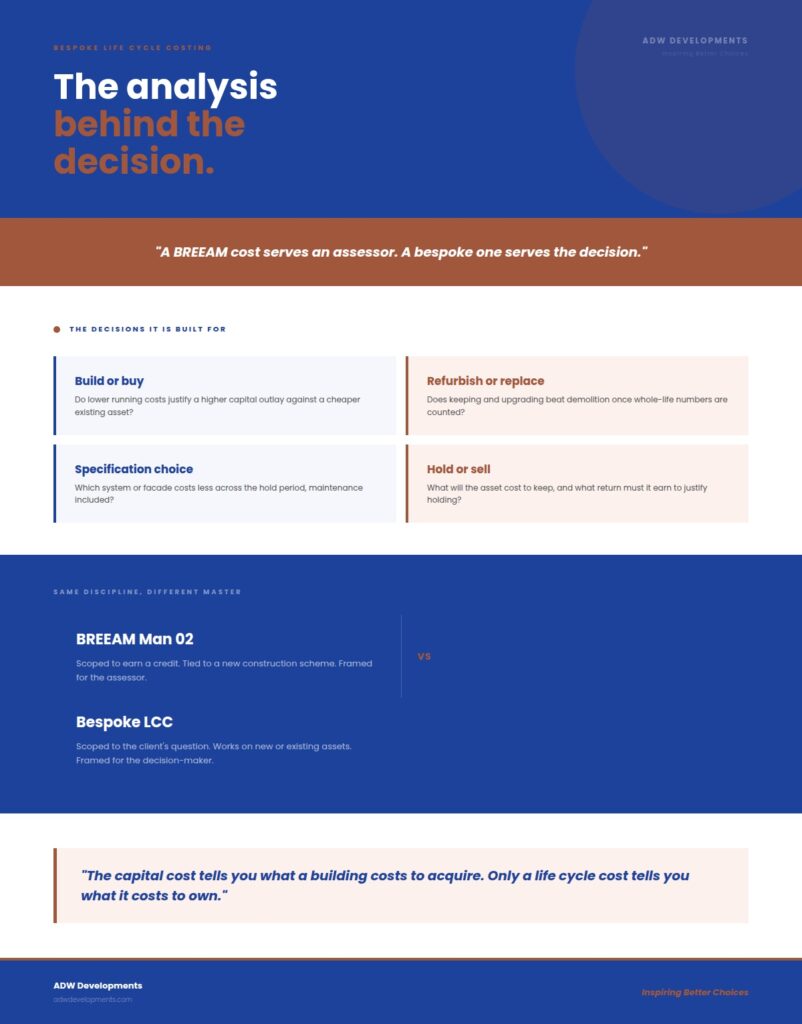
| A BREEAM life cycle cost is scoped to earn a credit. A bespoke one is scoped to answer a commercial question. The methodology is shared, but the purpose, and with it the value, differs. |
The Decisions It Is Built For
A bespoke life cycle cost earns its place whenever a decision turns on what an asset costs over time rather than what it costs today.
| The decision | What the LCC settles |
| Build or buy | Whether a new build’s lower running costs justify its higher capital outlay against an existing asset acquired more cheaply. |
| Refurbish or replace | Whether retaining and upgrading a building beats demolition and new construction once the whole life numbers, not just the build cost, are counted. |
| Specification choices | Which of two systems, facades or finishes costs less across the hold period, once maintenance and replacement are included. |
| Hold or sell | What an asset will cost to keep, and therefore what return it must generate to be worth retaining. |
| Procurement models | Comparing options such as a PFI or long lease against ownership, over the period each actually runs. |
None of these is a question of compliance. Each is a commercial question, and none can be answered from the capital cost alone.
It Applies to Existing Buildings, Not Only New Ones
Certification-driven costing can hide a useful point. Life cycle costing does not apply only to buildings on the drawing board.
ISO 15686-5 covers buildings and constructed assets “whether new or existing”. This matters because owners make many of their most significant decisions about buildings that already stand. Whether to acquire them, to refurbish or redevelop them. Whether to keep or sell them. A bespoke study suits this territory, where an assessment tied to a new construction scheme cannot reach.
For an investor appraising an acquisition, or an owner weighing the future of an ageing asset, this is frequently the most useful analysis available. It sits entirely outside the certification process.
| The most significant whole life cost decisions are frequently made about buildings that already exist. This is where a bespoke analysis is most useful, and where a scheme-tied assessment does not apply. |
What Distinguishes a Reliable Model
A life cycle cost is only as valuable as the confidence a decision-maker can place in it. Three qualities determine that confidence.
The first is transparency. A credible model states its discount rate, its period of analysis, its cost sources and its service life data in the open. The reader can then see what drives the result and test it. Assumptions nobody can examine are assumptions nobody can trust.
The second is sensitivity analysis. Future costs are uncertain, so a sound model shows how the conclusion shifts as the key assumptions shift. A result that holds across a plausible range of discount rates and cost growth is one a committee can act on. A result that rests on a single favourable input deserves caution.
The third is framing. The output must answer the question the client asked, in the terms the client uses. A net present value, an annual equivalent cost and a clear year-by-year cash flow serve an investment committee better than a single lifetime total. They match the way the committee finances the decision.
Where This Leaves Owners and Investors
Certification-driven costing is worthwhile, but a scheme scopes it to earn a credit, and a credit is not a decision. The questions that determine whether a project makes financial sense, build or buy, refurbish or replace, hold or sell, fall outside any scheme. They need analysis built for them.
We build life cycle cost models to ISO 15686-5, shaped around the question that matters to the client and answered in the terms they use.
Capital cost establishes what a building costs to acquire. Only life cycle costing establishes what it costs to own, and ownership is where most of the money goes.
ADW Developments supports the commercial decisions that sit outside certification. To discuss how we can help, please contact us here.