
A Circular Economy Statement is not a document most developers think about at the start of a project. Teams often encounter the CES once the design has advanced and the planning submission is taking shape. As a result, they treat it as a document to produce quickly rather than a tool to use strategically.
That is an expensive approach.
A Circular Economy Statement produced under time pressure, without a material strategy to draw on, rarely satisfies planning requirements. It creates conditions, triggers revisions, and delays consent. The cost of getting it wrong consistently exceeds the cost of getting it right from the start.
This article explains what a CES is, when projects require one, what it must contain, and where project teams most commonly fall short.
What a Circular Economy Statement Actually Is
A Circular Economy Statement sets out how a development will minimise waste and maximise resource efficiency across the full project lifecycle. It covers construction, occupation, adaptation, and end of life.
The statement is not a sustainability narrative. It is a technical document with specific content requirements. The CES needs to demonstrate how the project manages material flows, what materials enter the site, what materials leave it, what teams reuse, what they recycle, and what they send to landfill.
Planning authorities use the CES to determine whether a development genuinely integrates circular economy principles into its design and delivery, or whether the project team applied circular economy language retrospectively to a scheme that did not incorporate those principles from the outset.
| A CES produced after design is complete can only describe what the project does. A CES produced during design can shape what the project does. That difference determines whether it passes planning. |
When a CES Is Required
The clearest current requirement sits within the Greater London Authority framework. The London Plan (adopted March 2021) requires a Circular Economy Statement for major developments under Policy SI 7. The threshold covers residential schemes of ten or more units and commercial developments above 1,000 square metres.
Outside London, the picture is less uniform but moving in one direction. A growing number of local planning authorities now include circular economy requirements in their local plans or development management policies. Several ask for CES-equivalent documents without using the GLA’s exact terminology. Others reference the London Plan framework directly as best practice.
The direction of national policy is consistent with this trend. The National Planning Policy Framework places increasing weight on resource efficiency and waste minimisation. Circular economy requirements at the planning stage are not a London-specific phenomenon; they are becoming standard practice.
If your project meets the relevant thresholds and falls within a GLA area or a local authority that actively promotes circular economy principles, you should assume that a CES will be required. If you are uncertain, check at pre-application stage. Finding out at submission adds cost and programme risk.
How a CES Differs from BREEAM Wst 06
Project teams often treat a CES and BREEAM Wst 06 as two versions of the same document. They are not.
BREEAM Wst 06 is a credit-based assessment within the BREEAM scheme. The assessment measures functional adaptability by evaluating how easily a building can accommodate modification, extension, or repurposing throughout its life without requiring demolition. It focuses on design flexibility.
A Circular Economy Statement addresses material flows across the full project lifecycle. Its scope is broader, its evidence requirements are different, and it exists within a planning framework rather than a BREEAM assessment.
| Circular Economy Statement | BREEAM Wst 06 | |
| Framework | Planning policy | BREEAM assessment scheme |
| Focus | Material flows across full project lifecycle | Design flexibility and functional adaptability |
| Submitted to | Local planning authority | BREEAM assessor / BRE |
| Interchangeable? | No. They serve different purposes within different frameworks and require separate documents. | |
What the LWARB Framework Expects
The London Waste and Recycling Board (LWARB) produces the most detailed published guidance on what a Circular Economy Statement should contain for major developments in London. Even outside London, this framework represents the current industry benchmark and provides a useful structure for any CES.
The LWARB framework is staged. It expects different levels of detail at different points in the planning process.
At pre-application stage
The statement should set out the circular economy ambitions for the project, identify the material flows involved, and demonstrate how circular principles have informed the early design approach. This does not require precise quantities, but it does require genuine engagement with the question.
At planning application stage
The statement needs to be more specific. It should set out the construction material strategy, including targets for waste diversion from landfill, materials specified for reuse or recycled content, and arrangements for managing construction waste on site. For refurbishment schemes, it should draw on a Pre-Demolition Audit.
Post–construction
Where a pre-commencement condition applies, the project team prepares a post-construction CES to demonstrate how the development achieved the targets set out in the planning-stage statement. This document closes the loop and relies on records that the team maintains throughout construction.
| The LWARB framework applies primarily to GLA-overseen developments. For schemes outside London, check whether the relevant LPA has its own circular economy guidance or whether the LWARB framework is referenced as the applicable standard. |
What a Strong CES Contains
The following elements are present in a CES that satisfies planning requirements. They are also the elements most commonly missing from statements that generate conditions or revisions.
- A clearly defined strategic approach — refurbish, repurpose, deconstruct and reuse, or design for longevity and adaptability — set out in the GLA’s Table 1 format and justified with reference to the specific project context
- A Bill of Materials — covering estimated material quantities by building layer (structure, shell/skin, space as a minimum), material intensity in kg/m², and recycled content targets expressed as a percentage by value, with a minimum commitment of 20% recycled content where achievable.
- A Pre-Demolition Audit for schemes involving demolition — without it, reuse and diversion targets have no evidence base; the GLA guidance lists it as a required appendix, not an optional one.
- A Recycling and Waste Reporting Form. Covering demolition, excavation, construction, and operational waste streams, with estimated quantities and diversion rates against the London Plan targets of 95% reuse or recycling of construction and demolition waste and 95% beneficial use of excavation material.
- Reuse and recycled content commitments — which specific materials will incorporate recycled or reused content, where they will be sourced, and what the evidence base is.
- Construction waste management arrangements — contractor requirements, on-site segregation, SmartWaste monitoring, and the connection to the Site Waste Management Plan
- An operational waste strategy — storage provision, segregation for at least three waste streams, and collection arrangements for occupiers during the use phase
- An end-of-life strategy. How the building has been designed for disassembly, adaptability, or future material recovery, with reference to BREEAM Wst 06 where the scheme targets that credit
- A plans for implementation section — who is responsible for delivery, at what programme stage, and how performance will be monitored and reported
The Most Common Gaps
The same gaps appear repeatedly in Circular Economy Statements that generate planning conditions.
The most frequent is the absence of a Pre-Demolition Audit on schemes involving existing buildings. A CES that sets reuse targets without a material inventory to support them cannot demonstrate how those targets were arrived at or how they will be tracked.
The second is vague or aspirational language in place of specific commitments. Statements that refer to ‘maximising recycled content’ or ‘minimising waste to landfill’ without figures do not satisfy planning requirements. Assessors want targets and a method, not ambitions.
The third is a disconnect between the CES and the project programme. Waste management arrangements that are not reflected in contractor requirements, procurement strategies, or site logistics plans are unlikely to be delivered. The CES needs to connect to how the project actually runs.
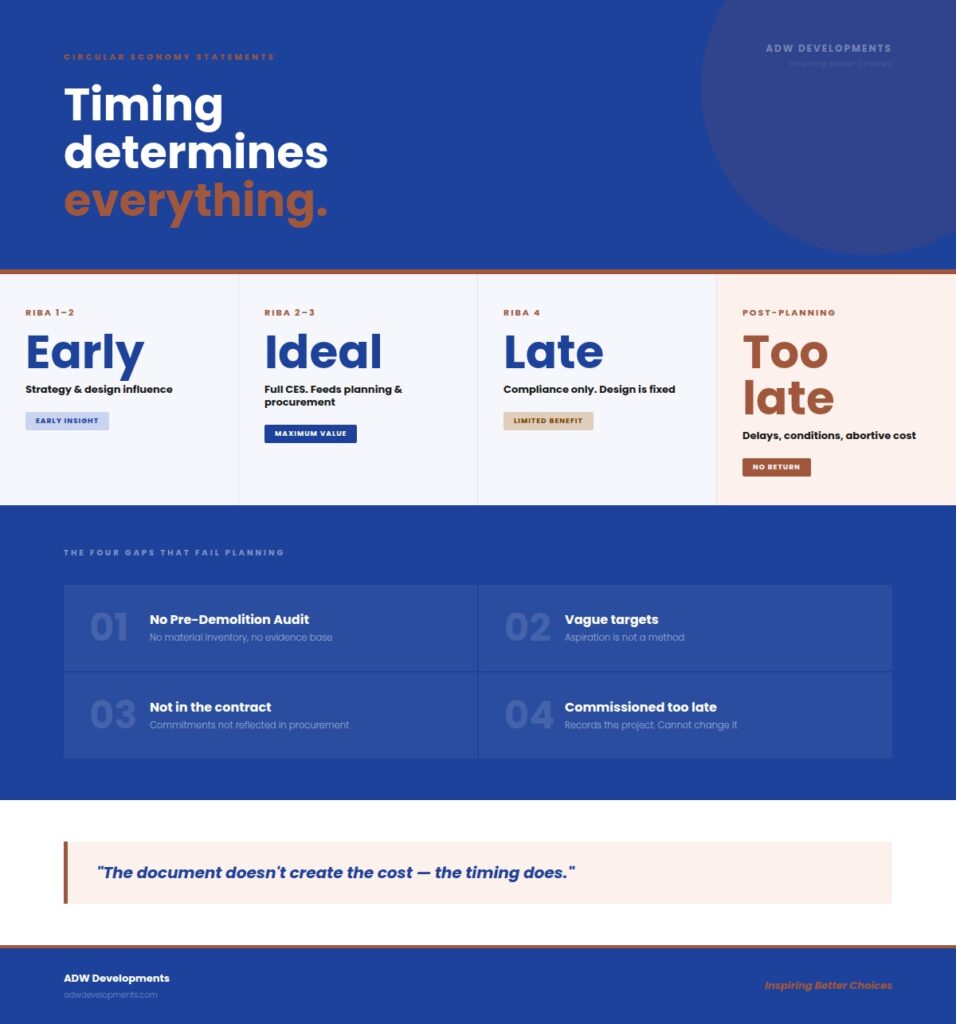
The fourth is late commissioning. A CES written after planning submission, or to satisfy a pre-commencement condition on a design that is already fully detailed, cannot influence the decisions that most affect its content. It records what the project does rather than shaping it.
The Commercial Case for Getting It Right Early
Planning delay on a major development has a direct cost. Conditions requiring a revised or supplementary CES extend the pre-commencement period. Redesign triggered by a late circular economy review, adjusting waste storage, revising the material specification, or retrospectively commissioning a Pre-Demolition Audit, adds professional fees and programme time.
The cost of a well-executed CES, commissioned at the right stage and built on a genuine material strategy, is fixed and predictable. The cost of a weak one is neither.
Beyond planning, a strong CES has secondary commercial benefits. Projects that demonstrate credible waste diversion and material reuse targets strengthen ESG reporting, improve their suitability for sustainability-linked finance, and provide the evidence that occupiers and investors increasingly expect when assessing circular economy performance.
The CES is not a cost of compliance. When project teams approach it properly, the CES becomes a practical tool that reduces waste disposal costs, informs procurement decisions, and supports planning, BREEAM, and investor reporting through a single coordinated process.
| Projects that treat a Circular Economy Statement as a planning formality consistently absorb more cost than those that treat it as part of the design process. The document does not create the cost — the timing does. |
What to Do Next
If your project is at feasibility or early design stage, now is the right time to establish a circular economy strategy. Project teams can produce a stronger, more credible, and more useful CES when they embed circular economy thinking before they fix the design.
If your project is already at the planning stage and a CES is a requirement, focus on specificity, targets, quantities, methods, and contractual hooks. Vague commitments do not pass.
If you are unsure whether you need a CES, check at pre-application stage. The answer is almost always yes for major developments, and finding out early costs nothing.
Contact us to work on CES.