
For many project teams, third-party verification of Mat 01 under BREEAM Version 7 is seen as a technical requirement. It is often passed to a sustainability consultant and treated as a task to complete.
For developers, investors and cost consultants, it means more than that. It is a way to protect asset value, strengthen planning submissions, and demonstrate credible sustainability performance. These are all factors that funders and occupiers now expect.
This article explains what third-party verification involves and why early engagement can improve outcomes.
The Shift Introduced by BREEAM V7
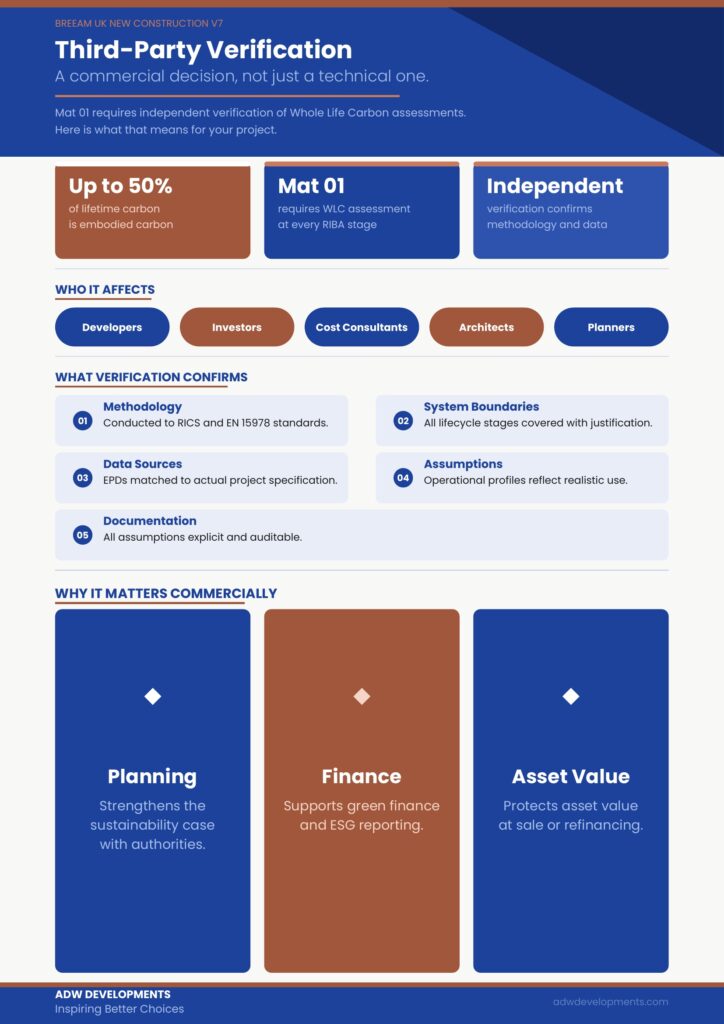
BREEAM Version 7 raises the standard for credible evidence. Earlier versions allowed more flexibility in how carbon and lifecycle data were presented. Version 7 is stricter. Methodology must be transparent. Assumptions must be justified. Assessments must align with recognised standards such as RICS Whole Life Carbon guidance and EN 15978.
Assessors are also under greater scrutiny. Previously, carbon figures were often accepted without detailed review. Version 7 requires clear and defensible reasoning behind every figure.
Third-party verification under Mat 01 provides this assurance. It confirms that the Whole Life Carbon assessment meets the required standard. It also checks that data sources are appropriate and that the methodology is robust. Under Mat 01, it is an exemplary credit. It becomes a minimum requirement only for projects targeting a BREEAM Outstanding rating. For Pass, Good, Very Good or Excellent ratings, it remains optional. However, it can significantly strengthen the quality of evidence.
This shift changes the approach for teams that previously managed assessments internally or relied on a single consultant.
What This Means for Developers
Developers now face a more demanding evidence environment. The carbon assessment is no longer a background document. It contributes directly to credits, informs planning conditions, and is often reviewed during refinancing or sale.
Weak assumptions or inconsistent boundaries can create real risks. Data that cannot be verified reduces confidence. These issues affect planning outcomes, investor trust, and the market position of the asset.
Independent verification adds assurance. It helps ensure that the assessment will stand up to scrutiny from assessors, planners, lenders and buyers. For Outstanding ratings, it is also required.
At ADW Developments, we support developers from early design stages. We ensure that Whole Life Carbon evidence is structured correctly before verification. This reduces revisions, lowers the risk of credit loss, and improves documentation quality throughout the project lifecycle.
What This Means for Investors and Asset Managers
ESG reporting is now a core requirement for institutional investors. Funders and asset managers are examining sustainability claims in greater detail, particularly carbon data.
A BREEAM-certified asset with independently verified carbon data carries more weight. It shows that the methodology is sound and that the results are credible.
This is especially relevant for assets seeking green finance. It also matters for portfolios subject to SFDR or TCFD reporting. In addition, lenders are increasingly introducing sustainability covenants.
Third-party verification supports risk management. It reduces the chance of claims being challenged and provides reliable evidence for long-term decision making.
What This Means for Cost Consultants
For quantity surveyors and cost consultants, Whole Life Carbon is becoming central to their role. Carbon decisions affect cost across the entire building lifecycle.
Specification choices influence capital cost, maintenance, replacement and operational performance. These factors must be assessed together.
Where verification is required, the quality of cost data becomes even more important. An independently reviewed assessment provides a stronger basis for long-term cost planning.
ADW Developments integrates Whole Life Carbon and Life Cycle Costing. This ensures that carbon assessments align with financial performance. It supports compliance, business cases, value engineering and long-term strategy.
Getting Verification Right
Verification depends on the quality of the original assessment. Common issues include:
• Inconsistent system boundaries with unclear justification
• Unsupported data sources or misaligned EPDs
• Unrealistic operational carbon assumptions
• Missing or unclear documentation
Preparation should start early. A clear structure, precise methodology, and well-documented assumptions are essential.
BREEAM V7 sets clear criteria for an independent third party, following KBCN1805 and ISO 17029. The verifier cannot take part in the project or advise on it. Related or parent companies do not qualify. Project teams must confirm independence before appointment.
LCA Stages Under BREEAM V7
BREEAM V7 includes Life Cycle Assessment credits at three stages. These are Concept Design, Technical Design and Post Construction.
These credits can be achieved separately. They are only all required for an Outstanding rating. For an Excellent rating, one stage is sufficient.
Early engagement is strongly recommended. A Concept Design LCA offers the greatest opportunity to reduce embodied carbon. Decisions made at this stage have the most impact.
The ADW Approach
ADW Developments provides independent technical consultancy supporting BREEAM Version 7 compliance across multiple disciplines Whole Life Carbon Assessment, Life Cycle Costing, Circular Economy Strategy, Durability and Resilience, and Post-Occupancy Evaluation.
We are not a BREEAM assessor; we provide rigorous, evidence-led analysis that supports assessors and strengthens each project’s sustainability case.
For Mat 01, we develop Whole Life Carbon assessments designed for independent verification from the outset. We set out a clear methodology, define transparent assumptions, and align the assessment with RICS guidance and EN 15978 requirements.
We work directly with developers, investors, cost consultants, architects, and planning teams. Moreover, we engage early, typically from RIBA Stage 1 or feasibility, so sustainability performance shapes project decisions from the start rather than being added later
If you are working on a BREEAM Version 7 project and would like to discuss how third-party verification fits into your programme, contact ADW Developments to arrange a conversation.