
What Comes Next?
Each Earth Day offers the built environment sector a moment to take stock. To ask not just how far we have come, but whether the direction of travel is still right.
Net zero has been the defining ambition of the last decade. It shaped policy, guided investment decisions, and reframed how we think about buildings, not just as structures, but as assets with long-term environmental consequences. That shift was necessary and it mattered.
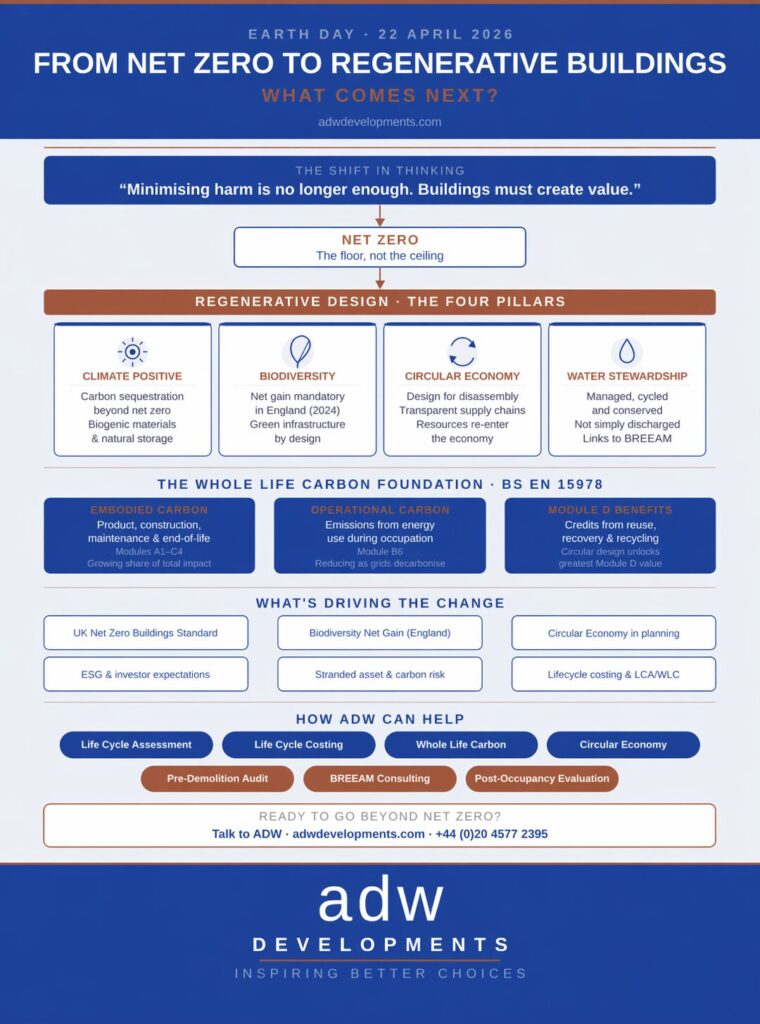
But the conversation is moving on.
Across the industry, leading practitioners, investors and clients are beginning to ask a more ambitious question: what if buildings did not simply stop causing harm, but actively contributed to a healthier built environment? Welcome to the era of regenerative design.
Net Zero Is a Floor, Not a Ceiling
Net zero means reaching a balance between the carbon emissions a building produces and the carbon it avoids or offsets. It is a meaningful target, and one that remains genuinely challenging to achieve in practice.
But balance is not the same as contribution. A building that relies heavily on offsets, or achieves compliance through minimal operational energy whilst generating significant embodied carbon in construction, is meeting a threshold, not transforming outcomes.
The science increasingly points in one direction: stabilising the climate will require more than emissions reduction. It requires carbon drawdown, ecosystem restoration, and built assets that support, rather than deplete, the natural systems they sit within.
Net zero is, at best, the starting point.
“Minimising harm is no longer enough. Buildings must create value.”
What Regenerative Design Actually Means
Regenerative design is not a single standard or a box to tick. It is a way of thinking about what buildings can give back across their whole life cycle. In practice, it encompasses four intersecting priorities.
Climate-positive performance. Going beyond carbon neutrality to buildings that actively sequester more carbon than they emit over their lifetime. ADW approaches climate-positive outcomes through whole life carbon strategy and life cycle assessment, identifying where embodied carbon can be reduced and where circular design creates the greatest long-term gains.
Biodiversity and ecological value. Buildings and developments that support local ecosystems, increase green infrastructure, and treat biodiversity net gain not as a planning obligation but as a genuine design priority.
Circular resource flows. Designing for disassembly, specifying materials with transparent supply chains, and planning for the end-of-life of every component so that resources re-enter the economy rather than ending up in landfill.
Water stewardship. As explored in our recent post on water performance in BREEAM and whole life carbon, water is increasingly inseparable from a credible environmental strategy. Regenerative buildings treat water as a resource to be managed, cycled, and conserved, not simply discharged.
The Whole Life Carbon Foundation
Regenerative ambition needs to be grounded in measurement. This is where whole life carbon assessment, structured around BS EN 15978 and the RICS Professional Standard, becomes essential.
Understanding the full carbon footprint of a building, from raw material extraction through to end-of-life, is what allows design teams and clients to identify where impact is greatest and where genuine improvement is possible. It also makes it harder to hide behind narrow compliance metrics.
A building that performs well on operational carbon (Module B6) but carries a high embodied carbon burden from its structure and envelope is not a regenerative asset. Whole life thinking closes that gap. As electricity grids decarbonise, upfront embodied carbon is becoming an increasingly significant share of total impact and the focus of serious design effort.
Similarly, lifecycle costing aligned with carbon strategy ensures that the financial logic of better-performing buildings is visible. Long-term value and lower environmental impact are not in opposition. When assessed properly, they typically reinforce each other.
Where the Industry Is Heading
Leading organisations are already treating regenerative design as a strategic framework, not a future ambition. They prioritise whole life performance and move ahead of regulation.
Market expectations are rising. ESG frameworks, green finance and rating systems are redefining what a high quality asset looks like. Poor performers face stranded asset risk, carbon costs and declining appeal.
Policy is catching up. Biodiversity net gain is now mandatory in England. Circular economy statements are increasingly required. The emerging UK Net Zero Carbon Buildings Standard is raising the bar, supported by the Environmental Improvement Plan 2025, which sets long-term direction for nature recovery and resource use.
Our Perspective
At ADW, we work across the full spectrum of whole life performance, from life cycle assessment and carbon strategy through to circular economy planning and resource efficiency. Earth Day is a useful moment to look up from the day-to-day and consider the bigger picture.
Net zero remains the right target for many projects right now. But the most forward-thinking clients and developers we work with are already asking what comes after it. They are not waiting for regulation to define the ceiling.
They are building it.
If you are exploring how to embed whole life carbon and circular economy into your projects, we would be glad to have that conversation.