
If you have worked on any significant development project in recent years, you have likely encountered both of these documents. And you may have wondered whether they are essentially the same thing with different names.
The honest answer is: almost, but not quite.
Both a Crime Prevention Statement and a Security Needs Assessment share the same core purpose to ensure that a building or development has been designed with safety and security in mind. They both draw on Crime Prevention through Environmental Design (CPTED) principles. Both consider the same kinds of issues: natural surveillance, access control, defensible space, boundary treatment, and lighting. And both are typically required at the planning or BREEAM stage to demonstrate that security has been considered from the outset.
So where do they diverge? The difference is largely one of context, audience and depth.
The Crime Prevention Statement
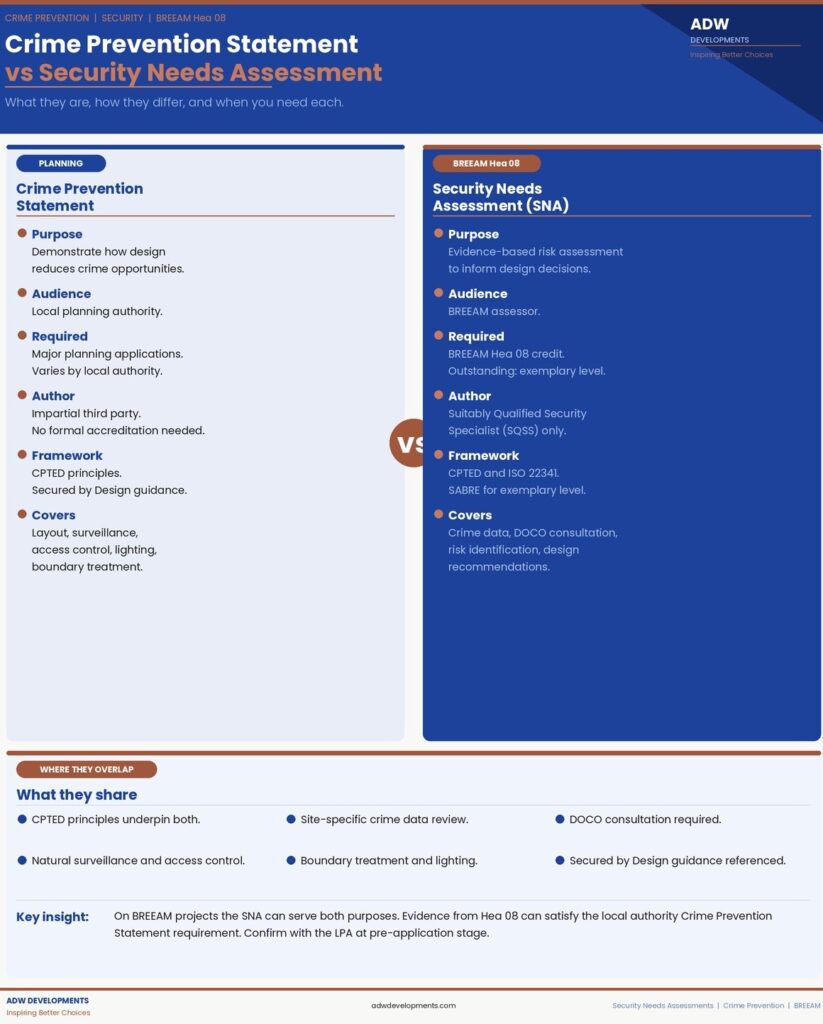
A Crime Prevention Statement is a planning document. Local planning authorities across England often require it as part of a valid planning application, particularly for major developments. The terminology varies by council, some call it a Crime Prevention Statement, others a Crime Impact Statement, a Crime Risk Statement or a Safer Places Statement. The underlying intent is the same regardless of the label.
Its purpose is to demonstrate how the proposed development responds to local crime and disorder issues. It does this through the lens of CPTED, addressing how design choices such as layout, building orientation, boundary treatment, lighting and landscaping work together to reduce opportunities for crime. The document typically includes a review of local crime data, consultation with the local police Designing Out Crime Officer (DOCO), and a set of design responses linked to the five CPTED principles.
It is primarily a planning tool. The audience is the local planning authority. It supports the validation and determination of the planning application. It does not need to be produced by a formally accredited specialist, though it should be well-evidenced and site-specific. Many local authorities require it to be authored by an impartial third party.
Secured by Design, the official UK Police initiative, underpins much of the guidance that informs these statements. Where a development achieves Secured by Design accreditation, this is often reflected positively in the Crime Prevention Statement.
The Security Needs Assessment
A Security Needs Assessment (SNA) is a more structured, technical document. It is most commonly associated with BREEAM compliance, specifically the Hea 06 credit (known as Hea 08 in BREEAM V7) under the Health and Wellbeing category.
To meet the BREEAM credit requirements, the SNA must be carried out by a Suitably Qualified Security Specialist (SQSS). This is not a loose term. The SQSS must meet defined criteria: a minimum of three years’ relevant experience in a security profession in the last five years, and membership of a recognised professional body with a code of conduct. Alternatively, they can hold registration with a BREEAM-recognised third-party scheme, such as SABRE.
The SNA follows a structured methodology. It includes a visual audit of the site and surroundings, formal consultation with relevant stakeholders including the DOCO and, where applicable, Counter Terrorism Security Advisers (CTSAs), a crime pattern analysis for the immediate area, and identification of risks specific to the building’s use and intended users. Crucially, the recommendations that emerge from the SNA must then be implemented in the design.
For projects seeking the exemplary level credit under Hea 06, a further step is required. The project’s performance must be confirmed through independent assessment and verification against a compliant risk-based security rating scheme. Currently, SABRE (Security Assurance By Resilience Engineering) is the recognised scheme for this purpose.
The SNA is a technical compliance document. Its primary audience is the BREEAM assessor. It goes beyond planning validation into formal risk assessment and design integration.
Where They Overlap. Why That Matters
In practice, a well-produced Security Needs Assessment will cover much of the ground that a Crime Prevention Statement would address. The CPTED principles are central to both. The site analysis, crime data review and DOCO consultation that feature in the SNA are the same elements a planning authority would expect to see in a Crime Prevention Statement.
This means that on BREEAM projects, the SNA can often serve a dual purpose. The evidence gathered for the BREEAM credit can be presented, sometimes with minimal adaptation, to satisfy the local planning authority’s Crime Prevention Statement requirement. This avoids duplication and reduces cost. It is worth confirming this with the local authority at the pre-application stage, as requirements vary.
The key difference remains one of formality. The SNA has a defined author (the SQSS), a structured methodology and a BREEAM-specific compliance framework. The Crime Prevention Statement has more flexible authorship requirements but is shaped by local planning policy, which differs from authority to authority.
Who Needs to Know This?
For developers and project managers, understanding the distinction matters from a programme perspective. If your project requires BREEAM and planning consent, as most major developments do, you need both documents. Engaging an SQSS early means the SNA can be designed to serve both purposes from the outset. That saves time, cost, and duplication later in the process.
For architects and design teams, both documents carry design implications. The recommendations from either document need to be embedded in the scheme, not bolted on at the end. Security measures work best when they are part of the design, not an afterthought.
For cost consultants, neither document is simply a paper exercise. Both carry design consequences, and those consequences have cost implications. Boundary treatments, lighting strategies, access control infrastructure and physical security measures all flow from the recommendations made.
The ADW Approach
ADW Developments provides Security Needs Assessments for BREEAM projects, carried out by Suitably Qualified Security Specialists. We work from early design stages, typically RIBA Stage 2, to ensure that security recommendations are integrated into the scheme rather than imposed upon it. Where a Crime Prevention Statement is also required for planning, we can coordinate both documents to avoid duplication.
If you are working on a development that requires BREEAM compliance or has a planning condition requiring security documentation, speak to us early. The sooner security is on the agenda, the better the outcome. For the building, its users, and the surrounding community.