
As promised last week, we continue our focus on the UK Net Zero Carbon Buildings Standard (NZCBS) 2025.
In today’s article, we first break down the types of emissions it covers, the life cycle reporting requirements, current performance limits, and the key design and operational measures for compliance. Additionally, it highlights forthcoming changes and sets the stage for practical, real-world examples to follow.
Understanding these requirements is essential for any organisation serious about achieving net zero alignment.
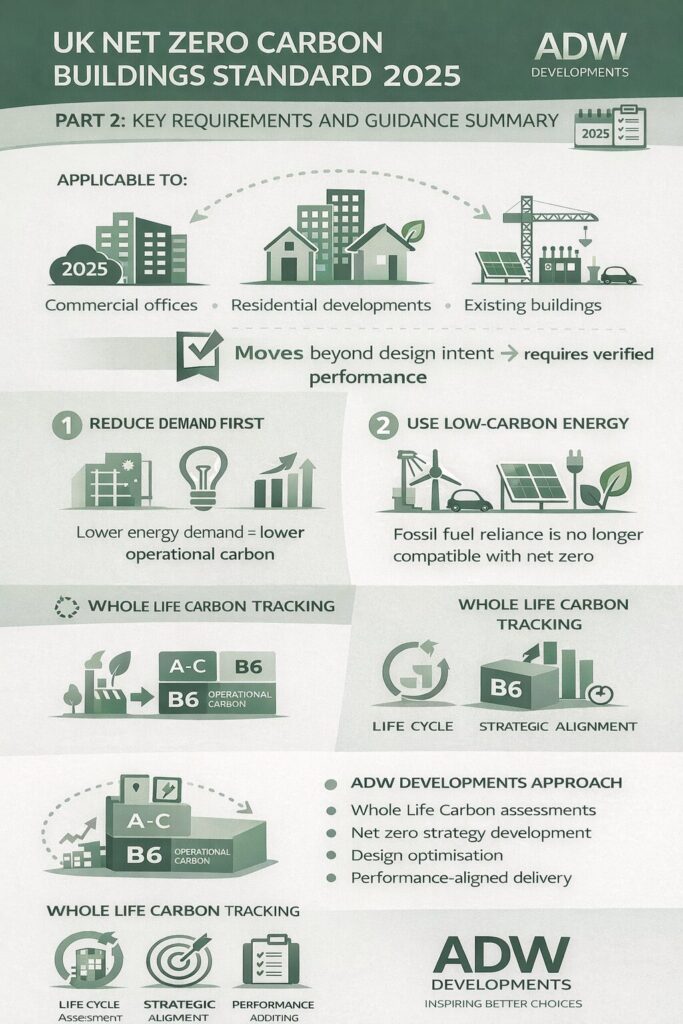
Breaking Down Carbon: What Emissions Does NZCBS Track?
The NZCBS takes a comprehensive approach to defining what net zero carbon means by addressing two major categories of carbon emissions:
Embodied Carbon: The Hidden Footprint
This covers all the carbon emissions associated with materials and construction, including:
- Extraction of raw materials
- Manufacturing of building products
- Transportation to site
- Construction processes
- Maintenance and refurbishment
- End-of-life disposal
Think of embodied carbon as the “upfront” carbon cost of your building before anyone even moves in. Reducing this upfront impact is fundamental to delivering a truly net zero asset.
Operational Carbon: The Day-to-Day Impact
This addresses all the emissions from actually using the building: heating and cooling, lighting ventilation, hot water, appliances and equipment.
Operational carbon is measured via in-use data over at least 12 months, ensuring the building performs as intended in real-world conditions.
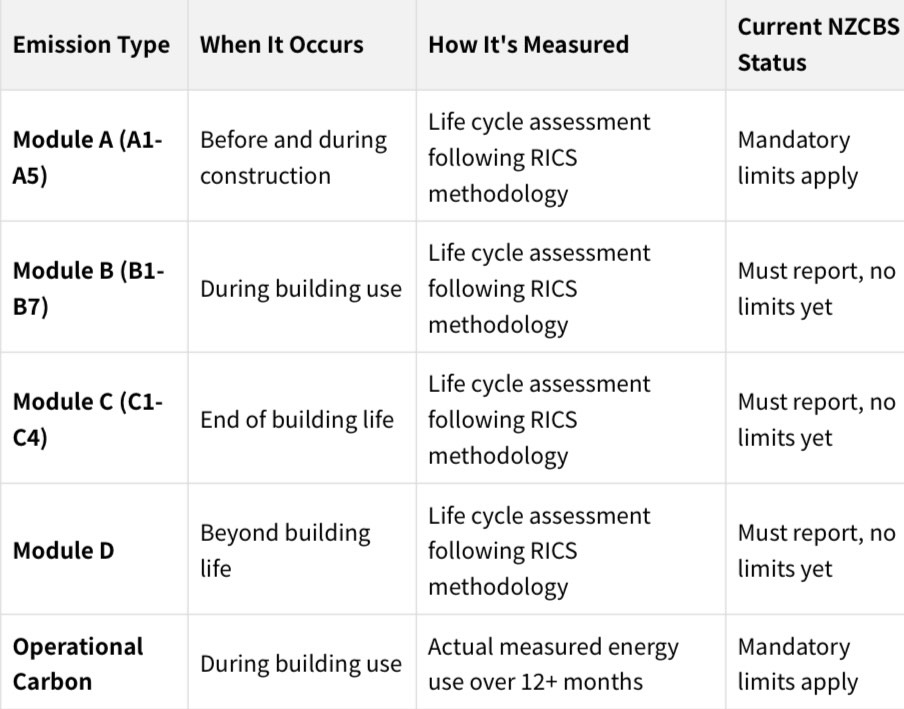
Whole Life Carbon Modules: What You Need to Report
The NZCBS follows the life cycle modules defined in the RICS Professional Standard for Whole Life Carbon Assessment, which is based on BS EN 15978. Here’s what you need to know about reporting requirements.
Module A: Product and Construction Stages
Current Status: Has mandatory upfront carbon limits (A1-A5)
What to Report: All emissions from raw material extraction through construction
Compliance Impact: Direct impact on NZCBS alignment status
Module B: Use Stage
Current Status: Must be reported but no mandatory limits in current version
What to Report: Emissions from maintenance, repair, replacement, refurbishment, and operational use
Compliance Impact: Required for reporting but doesn’t affect current alignment status
Module C: End-of-Life Stage
Current Status: Must report; limits not yet mandatory.
What to Report: Emissions from deconstruction, transport, waste processing, and disposal
Compliance Impact: Required for reporting but doesn’t affect current alignment status
Module D: Beyond Building Life
Current Status: Must be reported but no mandatory limits in current version
What to Report: Potential benefits from reuse, recovery, and recycling
Compliance Impact: Required for reporting but doesn’t affect current alignment status
Therefore, all modules must be assessed and reported in line with the RICS methodology, but only Module A currently carries mandatory performance limits. The NZCBS Pilot Version states that future updates of the Standard will introduce life cycle embodied carbon limits for Modules B, C, and D. This staged tightening reflects the UK’s structured pathway to net zero across the built environment.
Embodied Carbon Benchmarks: The Numbers You Need to Know
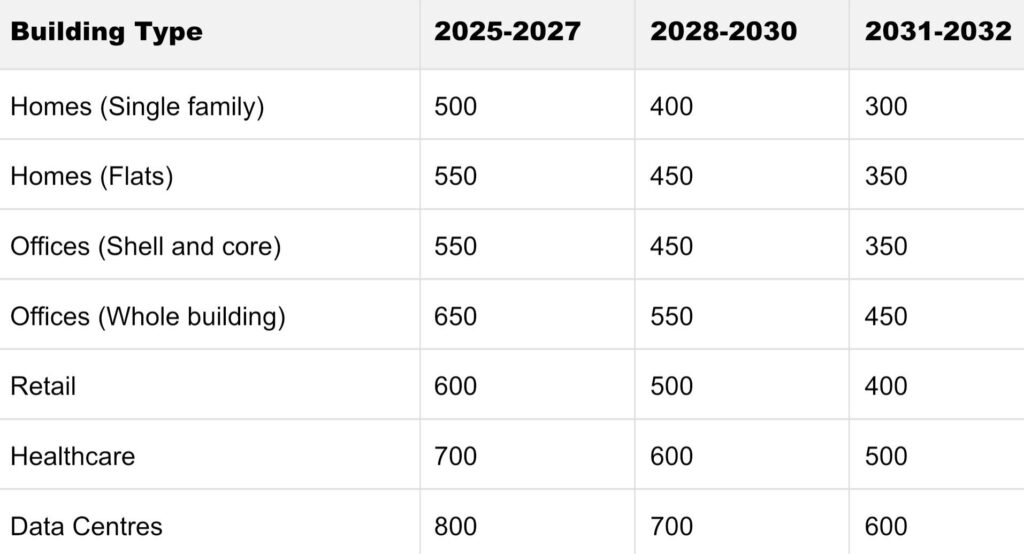
The NZCBS sets specific upfront carbon limits (for modules A1-A5) that vary by building type and get stricter over time. Here’s a simplified breakdown of the key benchmarks.
For New Construction (kgCO2e/m² GIA)
For Retrofit Works (kgCO2e/m² GIA)
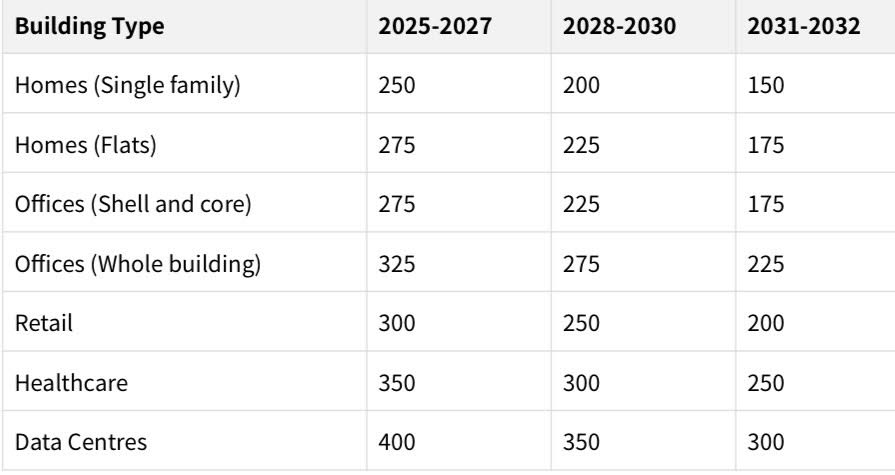
These limits are expressed in kilograms of carbon dioxide equivalent per square metre of Gross Internal Area. Moreover, they represent the maximum allowable upfront carbon emissions for buildings seeking to align with NZCBS. Notice how the limits get progressively tighter over time – this reflects the UK’s pathway to net zero and gives the industry time to adapt while maintaining momentum.
No More Fossil Fuels On-Site: The All-Electric Future
Perhaps the most significant change is the standard’s ban on the use of fossil fuels on-site, including gas boilers and hobs.
This means:
- electric heating systems (typically heat pumps) are the way forward
- induction cooking instead of gas hobs
- no natural gas connections for new buildings
The Standard allows limited exceptions for critical backup systems where no viable alternative exists, but these remain narrow and specific.
Mandatory Renewable Energy Generation: Buildings as Power Plants
Buildings must include on-site renewable energy generation, typically solar PV, measured per square metre of footprint.
For example:
- Homes need to generate approximately 60-75 kWh/m² of roof area
- Commercial buildings have varying requirements based on type and size
This pushes buildings toward becoming energy producers, not just consumers.
Strict Energy Performance Limits: Efficiency First
The standard sets absolute limits on:
- Annual energy use intensity (kWh/m²/year)
- Peak energy demand for heating and cooling (W/m²)
These limits vary by building type and sector but are designed to align with the UK’s carbon budget pathway. They also tighten over time, with stricter requirements coming into force in future years.
Low-GWP Refrigerants Only: Beyond Carbon Dioxide
With the shift to heat pumps and active cooling, refrigerants become a critical consideration.
The NZCBS requires:
- Only low Global Warming Potential (GWP) refrigerants
- Annual carbon impact limits for refrigerant leakage
This means careful selection of HVAC systems and regular maintenance to prevent leaks.
In our next post, we will take a closer look at NZCBS in Practice by discussing real-world examples. Furthermore, we will cover a benchmark summary of the key NZCBS requirements, the verification process for demonstrating net zero status, and practical steps to prepare your building for compliance. Delivering net zero is no longer theoretical; it requires measurable action across the full building lifecycle.