
Energy procurement is often treated as a commercial exercise, focused on tariffs, supplier selection, and short-term cost. In a net zero context, that mindset is no longer enough.
Energy Procurement and Whole Life Carbon: The Module B6 Connection
Within whole life carbon assessments, Module B6 accounts for operational energy use over the lifetime of a building. For many asset types, particularly commercial and operationally intensive buildings, Module B6 represents a significant proportion of total life cycle emissions.
In simple terms, how a building uses energy and how that energy is sourced will heavily influence its long-term carbon performance.
While energy efficiency measures such as fabric performance, system efficiency, and controls are critical, the carbon intensity of the energy itself also plays a defining role.
Two buildings with identical energy demand can have materially different operational carbon outcomes depending on how energy is procured.
This means that energy procurement decisions directly influence:
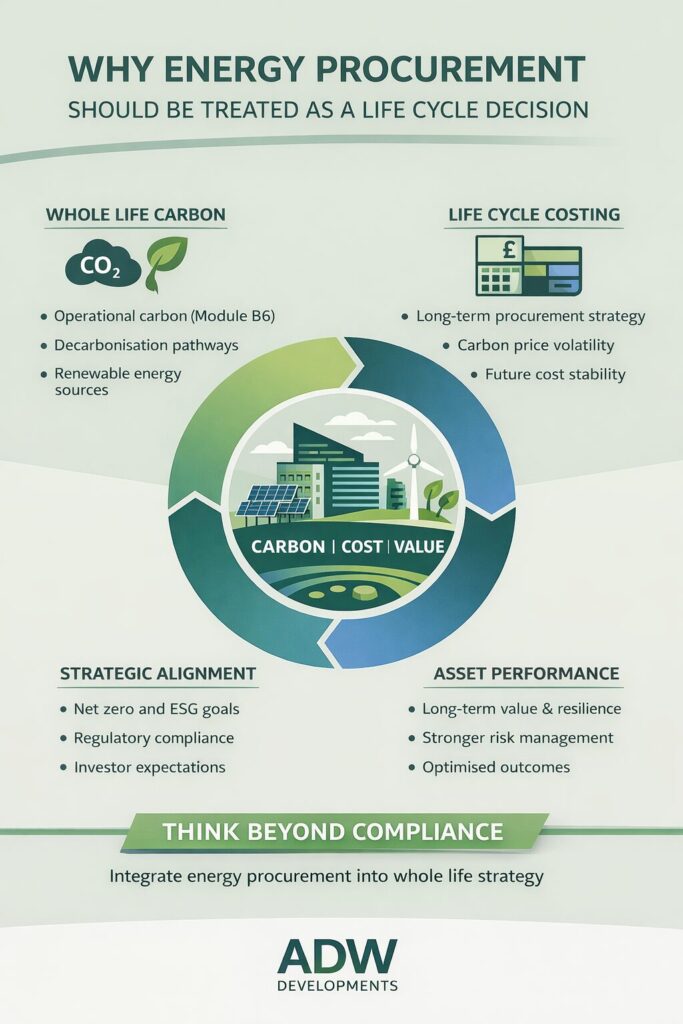
- Operational carbon performance
- Whole life carbon outcomes
- Alignment with net zero pathways
- Long-term regulatory and reporting compliance
When viewed through this lens, procurement is not an administrative task; it is a strategic performance lever.
Moving Beyond Short-Term Cost Thinking
Energy procurement has historically been driven by short-term cost optimisation. Fixed-term contracts, supplier switching, and tariff selection are typically evaluated based on immediate financial considerations.
While cost remains important, focusing solely on short-term pricing can create long-term exposure.
This approach can overlook:
- Exposure to carbon price volatility
- Misalignment with net zero commitments
- Increased transition risk as regulations evolve
- Reduced ability to demonstrate environmental performance to investors and stakeholders
Life cycle thinking shifts the focus from short-term pricing to long-term value and performance.
This includes considering:
- Carbon intensity of energy supply
- Contract structures that support decarbonisation
- Alignment with asset holding periods
- Long-term operational cost stability
The question moves from “What is the cheapest contract today?” to “What supports performance over the life of the asset?”
Supporting Life Cycle Costing and Asset Value
Energy costs represent one of the most significant operational expenditures over the lifetime of a building. As energy markets evolve and carbon pricing mechanisms become more prominent, procurement decisions increasingly influence life cycle costs.
Strategic procurement can support:
- Improved long-term cost predictability
- Reduced exposure to future carbon-related costs
- Enhanced asset resilience to market and regulatory change
- Stronger financial performance over the asset lifecycle
For investors and asset managers, this contributes directly to protecting and enhancing asset value.
Operational carbon performance is increasingly linked to valuation, investor scrutiny, and lending criteria.
Aligning Procurement with Net Zero and ESG Objectives
Net zero commitments and ESG reporting frameworks require organisations to understand and reduce operational emissions.
Energy procurement plays a critical role in enabling this transition.
Without a credible energy strategy, net zero targets risk becoming theoretical rather than deliverable.
Integrating procurement into sustainability strategy allows asset owners to:
- Reduce operational carbon intensity
- Demonstrate credible decarbonisation pathways
- Support ESG reporting and disclosure
- Align assets with future regulatory requirements
- Strengthen long-term portfolio performance
This is particularly important as disclosure frameworks, performance standards, and investor expectations continue to evolve.
Energy procurement is no longer separate from sustainability performance. It is central to it.
Energy Procurement as Part of Integrated Asset Strategy
Treating energy procurement as a life cycle decision requires early consideration and integration into asset planning and management processes.
This includes alignment with:
- Whole life carbon assessments
- Life cycle costing analysis
- Net zero carbon strategies
- Asset management plans
- Long-term ownership and operational objectives
Integration is what turns energy from a cost line into a managed performance driver.
By taking an integrated approach, energy procurement becomes a controlled and optimised component of asset performance.
This allows asset owners to actively manage carbon, cost, and risk over time.
From Compliance to Strategic Performance
As the built environment moves toward net zero, the distinction between compliance and performance is becoming increasingly important.
Compliance focuses on meeting minimum requirements at a specific point in time.
Strategic performance focuses on optimising outcomes over the full life cycle of an asset.
Energy procurement sits at the intersection of these objectives. When treated strategically, it supports:
- Lower operational carbon
- Improved life cycle performance
- Stronger asset resilience
- Better long-term financial outcomes
It becomes a proactive decision, not a periodic contract renewal.
Supporting Better Long-Term Outcomes
At ADW Developments, we recognise that achieving net zero requires a whole life approach. Energy procurement is a key component of this, influencing both environmental and financial performance over decades.
By integrating energy procurement into whole life carbon and life cycle strategies, developers, investors, and asset managers can take greater control of operational outcomes and future risk.
In a performance-led market, energy strategy is asset strategy.