
As the built environment accelerates its transition to net zero, operational energy, embodied carbon, and whole life carbon assessments have rightly become central to strategic decision-making. However, one critical performance metric is frequently overlooked in these conversations: water.
As we approach World Water Day, on the 22nd of March, it is essential to ask whether we can truly deliver high-performing, resilient, net zero buildings while treating water as a secondary consideration.
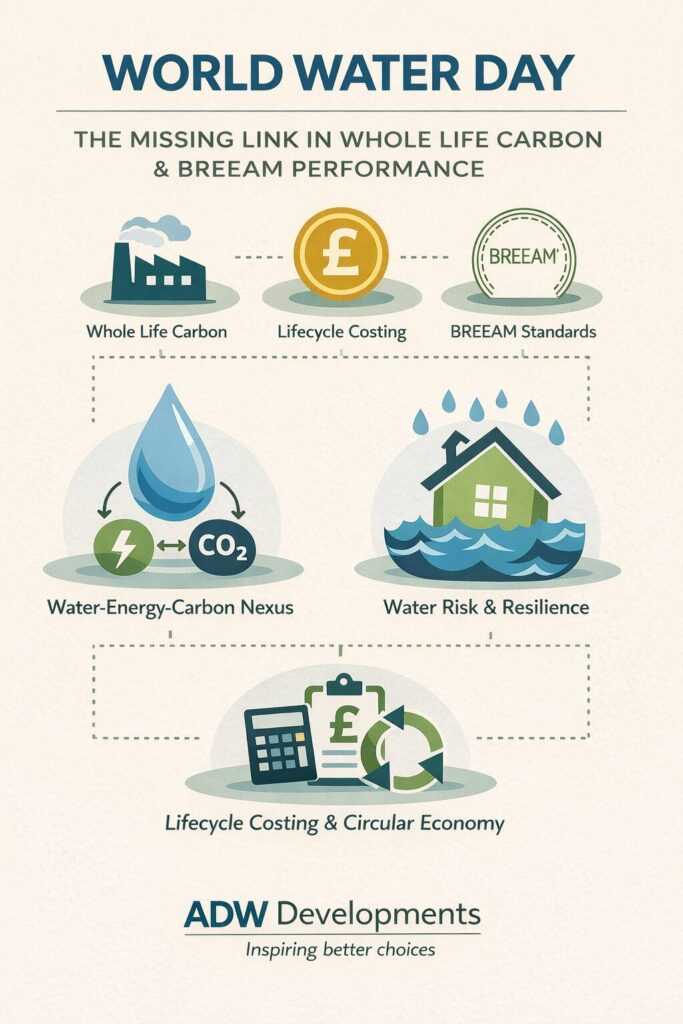
The Water-Energy-Carbon Nexus
The transition to net zero primarily focuses on reducing greenhouse gas emissions. Yet, buildings do not operate on energy alone. Water is intrinsically linked to operational carbon, lifecycle costs, climate resilience, and long-term asset value. In practice, water performance directly influences operational energy demand, particularly concerning hot water systems and pumping requirements.
It also affects cooling system efficiency, overheating mitigation strategies, and ongoing operational expenditure. When water strategy is separated from net zero strategy, significant opportunities for optimisation are lost.
Water and energy are deeply interconnected. Heating water for domestic use represents one of the largest contributors to operational energy consumption in many residential and commercial buildings. Likewise, pumping, treatment, and distribution all carry embedded energy demands. Reducing water consumption does not simply conserve a resource; it directly reduces operational carbon emissions. For example, lower hot water demand reduces gas or electricity use, while efficient fixtures decrease both water and energy consumption.
Intelligent controls can minimise unnecessary heating cycles, and closed-loop or optimised cooling systems reduce energy-intensive water use. In short, water efficiency supports net zero performance rather than existing separate from it.
BREEAM and Whole Life Performance
Environmental certification schemes like BREEAM increasingly recognise this interconnectedness. BREEAM has been designed to account for the whole life performance of buildings, assessing how a building performs over time. This holistic approach balances environmental, social, and economic impacts, ensuring that decisions made during design and construction consider resource consumption, occupant health, asset resilience, and resultant emissions.
Within the BREEAM framework, the ‘Wat’ category explicitly targets water efficiency and conservation. Credits are awarded for measures such as water monitoring (Wat 01 and Wat 02), which require the installation of meters and sub-meters to track consumption and identify anomalies. Furthermore, BREEAM addresses leak detection and prevention (Wat 03), encouraging systems that catch major leaks early and automatic shut-off valves that prevent small leaks from wasting significant volumes of water during unoccupied periods. These measures not only conserve water but also protect the asset from damage and reduce unnecessary operational energy use associated with pumping and heating wasted water.
Water Risk and Lifecycle Costing
Climate change is increasing water stress, drought frequency, and extreme rainfall events globally. For asset owners and developers, water risk is a material consideration within climate risk assessments and long-term portfolio strategy. Water scarcity can affect cooling system performance, landscape design, tenant operational continuity, and insurance risk profiles. Simultaneously, flood risk demands robust design responses, including sustainable drainage systems (SuDS) and resilience planning.
Water systems are frequently assessed based on capital expenditure rather than whole life value. However, lifecycle costing reveals a different reality. Over a building’s lifespan, water-related costs include supply and discharge charges, energy associated with heating and pumping, maintenance of plant and equipment, and potential retrofit costs in response to evolving regulations. A building that performs efficiently from day one will typically demonstrate lower operational expenditure, reduced exposure to future price volatility, and stronger long-term financial resilience.
Aligning Water Conservation with Consulting Services
The integration of water conservation across various technical and advisory domains illustrates its foundational role in sustainable development. The following table summarises how water efficiency aligns with the services delivered through ADW Developments:
| Service / Capability | Water Conservation Connection | Typical Measures or Outputs | Relevant Standards or Policy |
| Whole Life Carbon Assessment (WLCA) | Water demand influences operational energy use and associated carbon emissions, particularly where water heating or pumping occurs. | Reduced hot water demand, efficient plumbing systems, greywater reuse strategies. | RICS Whole Life Carbon methodology; UK Green Building Council Net Zero Carbon Framework. |
| Life Cycle Costing (LCC) | Water efficiency technologies can reduce operational expenditure over long analysis periods. | Rainwater harvesting, low-flow fixtures, greywater systems, water-efficient irrigation. | ISO 15686-5; HM Treasury Green Book discounting. |
| Circular Economy Statements | Water reuse supports circular resource management and reduced reliance on municipal supply. | Greywater loops, rainwater capture, closed water cycles in building systems. | Greater London Authority London Plan Policy SI5. |
| Planning and Sustainability Strategies | Planning submissions often require demonstration of water demand reduction and infrastructure resilience. | Potable water reduction targets, drought resilience strategies, sustainable drainage approaches. | Part G of the Building Regulations. |
| Environmental Certification | Water efficiency contributes to environmental rating systems used on developments. | Efficient sanitary fittings, water monitoring systems, leak detection infrastructure. | BREEAM Wat category credits. |
| Infrastructure and Landscape Strategy | Site planning influences water capture, drainage, and irrigation demand. | Sustainable drainage systems, permeable surfaces, water-efficient landscaping. | CIRIA SuDS Manual. |
| Digital Decision Tools | Analytical platforms can model water demand, cost, and carbon implications. | Water demand modelling, rainfall capture feasibility, operational water benchmarking. | Integrated modelling within WLCA, LCC, and circular economy tools. |
This alignment demonstrates that water conservation rarely functions as a standalone service. Instead, it operates as a supporting performance parameter across carbon modelling, cost forecasting, circular economy strategy, and planning compliance.
Conclusion
World Water Day is a reminder to widen the sustainability lens. If net zero is truly about long-term performance and resilience, water must sit alongside carbon in strategic planning. Buildings that integrate water, energy, and carbon from the outset are better prepared for future regulations, investor expectations, and climate realities.
The best-performing assets won’t just be low carbon, they’ll be water-efficient and built for a changing world. That’s where true performance lies.