
Two competent consultants assess the same building. They work from the same drawings and the same specification. Yet their whole life carbon figures come out different, sometimes by a margin that surprises the client. This is not a sign that one of them is wrong. It reflects how carbon assessment works. Understanding why helps clients read the numbers with the right kind of confidence.
Whole life carbon assessment follows a clear structure. In the UK, it rests on the standard BS EN 15978. The RICS Professional Statement on whole life carbon provides the methodology that sets out how to apply it. Together they divide a building’s life into defined modules: the product and construction stages, the use stage, and the end of life stage. On paper, the framework looks precise. In practice, applying it to a real building involves a series of judgements, and reasonable people can make those judgements differently.
The framework is shared. The inputs are not
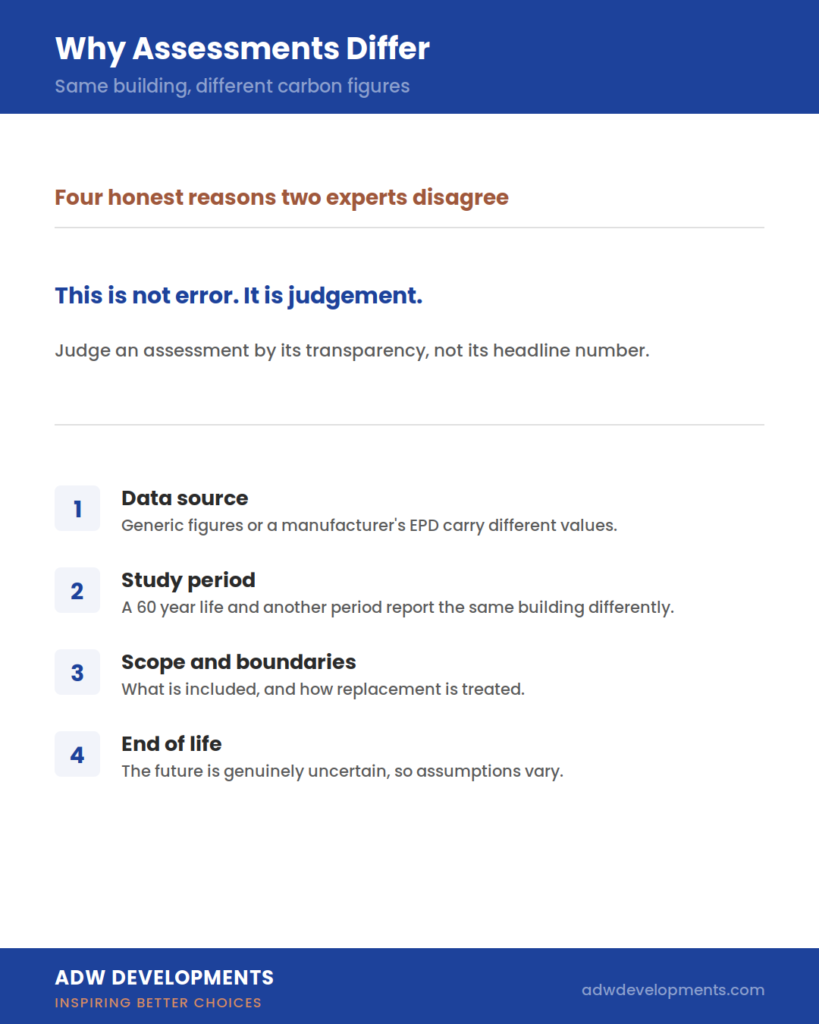
The modules are fixed, but what goes into them is not. An assessment depends on data about materials, and that data can come from several sources. A generic industry figure for a material carries one value. A manufacturer’s Environmental Product Declaration for the same type of material may carry another. Early in design, when the exact products are unknown, an assessor uses representative data and states the assumption. Later, as the team selects real products, the figures firm up. Two assessors may work at different stages, or draw on different data sources. They then produce different totals, for reasons that have nothing to do with competence.
The building’s assumed service life is another variable. Whole life carbon spreads certain emissions across the years a building is expected to stand and operate. Assume a sixty year study period and the annual picture looks one way. Assume a different period, as some clients or schemes require, and the same building reports differently. The assessor does not invent this number. It follows the brief, the standard, or the requirement being met, and a change in that assumption moves the result.
When judgement legitimately enters
Beyond data and study period, an assessment asks the assessor to make defensible choices about scope and boundaries. Which parts of the building are included. How to treat elements that will be replaced during the building’s life. How to handle the end of life stage, where the future is genuinely uncertain. No one knows exactly how a building will come apart decades from now. How to account for benefits beyond the building’s own boundary, such as materials that could serve again elsewhere. The standard records these separately, for good reason.
None of these are loopholes. They are the honest edges of a method that models the future, and the future does not offer exact figures. A good assessment does not hide these choices. It states them, so that anyone reading the result can see the assumptions it rests on. When two assessments differ, the explanation almost always lies in these stated choices, not in a hidden error.
Why this matters to a client
If assessments can differ, how should a client rely on them? The answer is to judge an assessment by its transparency and its consistency, not by whether its headline number matches someone else’s. A reliable assessment shows its working: the data sources, the study period, the scope, and how it treats each uncertain stage. That transparency lets a client compare options fairly. The comparison holds the assumptions steady and changes only the design variable under review.
This is also why consistency matters more than the single figure. The real value of carbon assessment is rarely the absolute number. It is the ability to compare two design options on the same basis and see which performs better. A concrete frame against a timber one. A refurbishment against a rebuild. Provided the same assumptions apply to both options, the comparison is sound. A different assessor, working to different assumptions, might report different absolute totals for each, and the comparison would still hold.
A client who understands this asks better questions. Rather than “is this the right number”, the more useful questions are simple. What data did you use? What study period? And what scope? Would the comparison still hold if we changed them? Those questions get to the heart of whether an assessment can be trusted to guide a decision.
Confidence in the right place
Carbon assessment is not less valuable because two experts can disagree. It is valuable precisely because, done well, it makes its reasoning visible and its comparisons fair. The number on the front page matters less than the clarity of the method behind it. A client who reads an assessment for its assumptions, not just its total, is a client who can act on it with confidence.
At ADW Developments, we build our whole life carbon assessments to be transparent and consistent. To discuss one for your project, get in touch.