
The transition to net zero is fundamentally reshaping how we evaluate buildings. We no longer judge performance solely at completion; we assess it across decades of operation. Yet financial and carbon decisions are still too often made in isolation, when in reality, they are inherently linked.
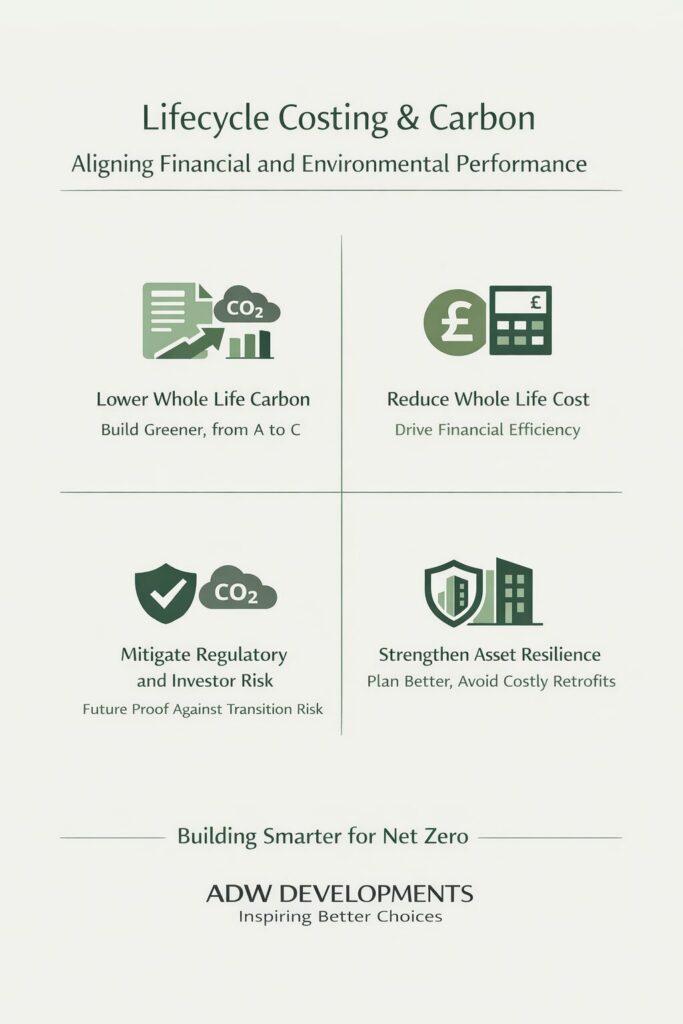
Lifecycle costing (LCC) and whole life carbon (WLC) assessment provide a shared framework for aligning financial and environmental performance across the full lifespan of an asset. When considered together, they support better investment decisions, lower long-term risk, and more resilient portfolios.
For developers, asset owners and investors operating in a net zero economy, this alignment is becoming essential.
Understanding Lifecycle Costing
Lifecycle costing assesses the total cost of a building over its entire life cycle. This includes:
- Capital expenditure (CAPEX)
- Operational expenditure (OPEX)
- Energy and utilities
- Maintenance and replacement
- Refurbishment
- End-of-life costs
Rather than focusing solely on upfront construction cost, lifecycle costing evaluates how design and specification choices influence financial performance over time.
This long-term view mirrors the structure of whole life carbon assessment, creating a natural opportunity to align cost and carbon strategy.
Whole Life Carbon: The Environmental Lens
Whole life carbon assessment measures total greenhouse gas emissions across a building’s life cycle, structured around the modules defined in BS EN 15978 and the RICS Professional Standard.
This typically includes:
- Embodied carbon (product, construction, maintenance, and end-of-life stages)
- Operational carbon (Module B6) — emissions from energy use during occupation
- Module D benefits from reuse, recovery or recycling
As electricity grids decarbonise, operational emissions are reducing. At the same time, upfront embodied carbon is becoming increasingly significant.
Achieving credible net zero performance therefore requires managing both.
And both have financial implications.
Why Alignment Matters
When cost planning and carbon assessment are undertaken independently, unintended trade-offs can occur.
For example:
- Selecting lower-cost materials may increase embodied carbon.
- Reducing capital expenditure on building fabric may increase long-term energy use.
- Installing cheaper plant may raise replacement and maintenance costs over time.
By assessing lifecycle costing and whole life carbon together, these trade-offs become visible.
The conversation shifts from “What is cheapest today?” to:
What delivers the strongest long-term value financially and environmentally?
In many cases, higher-performance fabric, efficient building systems and well-planned electrification reduce operational energy demand while stabilising long-term costs.
When properly evaluated, carbon efficiency and financial efficiency often reinforce one another.
Net Zero and Long-Term Risk
The UK’s legally binding net zero targets are reshaping regulatory frameworks, investor expectations and market behaviour.
Standards such as the UK Net Zero Carbon Buildings Standard, alongside tightening ESG disclosure requirements, are increasing scrutiny of operational and embodied emissions.
This creates material financial considerations:
- Exposure to future carbon pricing
- Energy price volatility
- Stranded asset risk
- Regulatory tightening
- Increased investor due diligence
Buildings with high operational emissions or poorly planned energy strategies may face rising compliance costs and reduced market appeal.
Conversely, assets designed with lifecycle performance in mind are better positioned to adapt as net zero requirements evolve.
From Capital Cost to Whole Life Value
A key shift for the built environment is moving from capital cost optimisation to whole life value optimisation.
This means:
- Evaluating energy systems based on lifetime performance, not installation cost
- Selecting materials based on durability and embodied carbon impact
- Planning replacement cycles strategically
- Integrating on-site renewables and electrification early
When lifecycle costing and carbon modelling are undertaken concurrently, ideally from early design stages, decision-makers can test scenarios and quantify long-term outcomes.
Late adjustments rarely deliver optimal results.
Early integration delivers control.
Investor Expectations and Asset Performance
Sustainability performance is increasingly influencing asset valuation, lending criteria and occupier demand.
Investors are asking clearer questions:
- How exposed is this asset to future regulatory change?
- What is its operational carbon trajectory?
- Are lifecycle costs predictable and resilient?
Lifecycle costing aligned with whole life carbon assessment provides structured answers.
It demonstrates that environmental ambition is underpinned by financial logic, not simply reporting obligations.
In a performance-led market, carbon efficiency is becoming an indicator of financial durability.
Delivering Performance, Not Just Compliance
Compliance sets minimum standards at a single point in time.
Lifecycle alignment optimises performance over decades.
When cost and carbon are assessed together, asset owners gain greater visibility of:
- Long-term operational expenditure
- Replacement cycles
- Energy demand trends
- Exposure to transition risk
This approach supports measurable, credible net zero pathways rather than aspirational targets.
It also reduces the likelihood of reactive retrofit costs later in an asset’s life.
A Strategic Opportunity
Lifecycle costing and carbon alignment are not additional complexity.
They offer a structured method for:
- Improving financial predictability
- Reducing environmental impact
- Strengthening asset resilience
- Supporting ESG commitments
- Protecting long-term asset value
For forward-thinking developers and investors, integrating these disciplines is rapidly becoming a defining characteristic of high-quality assets. Get in touch to explore how this approach can be embedded within your projects and wider strategy.