
Anthony Waterman is the Director of ADW Developments. With over 25 years in construction economics and sustainability, he leads one of the UK’s most respected specialist consultancies, advising on projects worth over £1 billion in construction value every year, and building the AI-powered assessment tools that are changing how that work gets done.
What sets Anthony apart is not just technical depth, but the use he makes of it. He sits on ISO, CEN, and BSI committees that shape how building performance is assessed worldwide. His conviction is simple: the built environment will not be transformed by good intentions, but by better decisions.
We sat down with Anthony to find out where that conviction comes from and what it looks like in practice.
ADW’s motto is ‘Inspiring Better Choices’. What does that mean in practice, and where did it come from?
Most projects are not won or lost by one big decision. They are shaped by hundreds of small decisions made every day.
At ADW, we believe that when people have the right information at the right time, they make better choices. Better choices reduce risk, unlock value, improve performance, and create more sustainable outcomes.
That is why we exist. We help project teams see beyond immediate costs and short-term pressures, giving them the insight needed to make decisions that stand the test of time. Inspiring Better Choices came from a simple observation: the future of the built environment will not be transformed by good intentions alone. It will be transformed by the choices, often simple choices, we make today. Our role is to make those choices clearer, easier, and more impactful.
You trained in Construction Economics, not environmental science. How does that shape the way you think about sustainability?
Completely. And honestly, I think it’s the thing that makes ADW different from most firms operating in this space.
Construction economics teaches you that every decision involves trade offs made under conditions of uncertainty. Resources are finite. Information is imperfect. People respond to incentives. The built environment is, at its core, an exercise in allocating scarce resources across long periods of time. That’s not a sustainability framework. That’s just reality. But it means I’ve never been able to look at carbon, cost, maintenance, and long term value as separate conversations. They’re the same conversation.
What that background also gave me is a deep scepticism towards the way the sustainability industry communicates its message. The dominant narrative in this industry is one of fear, restriction, and sacrifice. The world is heading for catastrophe. Buildings are the problem. Clients need to be forced into better behaviour through regulation and guilt. I think that framing is not only wrong, I think it’s counterproductive.
Fear gets attention in the short term. But it doesn’t build lasting engagement, and it doesn’t inspire the kind of innovation and investment that actually moves things forward. When people believe the future is bleak, they protect what they have rather than invest in something better. That’s not the psychology of progress.
Hayek and the wider Austrian economics tradition have had a strong influence on how I think about complex problems. They understood that knowledge is dispersed. No single expert, regulator or consultancy can see the whole picture from the centre. Progress depends on people closest to the problem being able to test ideas, respond to evidence and improve over time.
That perspective shapes my view of sustainability. I do not believe lasting change comes will come from fear and catastrophism, or from assuming that every answer can be imposed from the top down. Regulation matters, but it works best when supported by clear information, practical tools and incentives that help people make better decisions for themselves.
The opportunity for sustainability is to make better choices visible and commercially credible. When a project team can see that a lower-carbon option also reduces whole life cost, improves resilience and strengthens long-term value, the decision becomes more powerful. It is no longer just a compliance exercise. It becomes a better way to design, procure and manage the built environment.
That’s what I’ve seen happen, project after project, over twenty five years. And it’s why I remain genuinely optimistic, not as a marketing position, but as a considered view. The challenges are real. But so is humanity’s capacity to solve them. The built environment has an enormous opportunity to be part of that story. My job is to help clients see it that way too.
ADW Developments works on projects worth more than £1 billion each year. What do clients trust you to get right?
Our role is to see the whole picture. We look beyond upfront costs to understand operational expenditure, maintenance, replacement cycles, risk, and long-term value. That allows us to identify where investing more today can save significantly more tomorrow. Most importantly, we understand that projects only succeed when sustainability and commercial reality work together. A solution that looks good on paper but cannot be delivered has little value. Our job is to help clients uncover the opportunities where environmental performance, commercial success, and long-term resilience align. When they do, the result is not just a more sustainable project. It is a better investment, a stronger outcome, and, ultimately, a better choice.
If you could give every client one piece of advice before they started a project, what would it be?
Make your important decisions early. People often make the decisions that shape a project’s future long before construction begins. Get those right, and everything that follows becomes easier.
Too many project teams bring specialists in only after they have already made the major decisions. By then, the opportunity to influence cost, performance, carbon, and long-term value has largely passed.
You create the greatest value when the brief is still flexible, and options remain open. At that stage, the cost of change is at its lowest, while the opportunity to improve outcomes is at its highest. The best projects are not usually the ones with the biggest budgets. They are the ones who make the right choices early.
You sit on ISO, CEN, and BSI committees. How does that influence the advice you give clients?
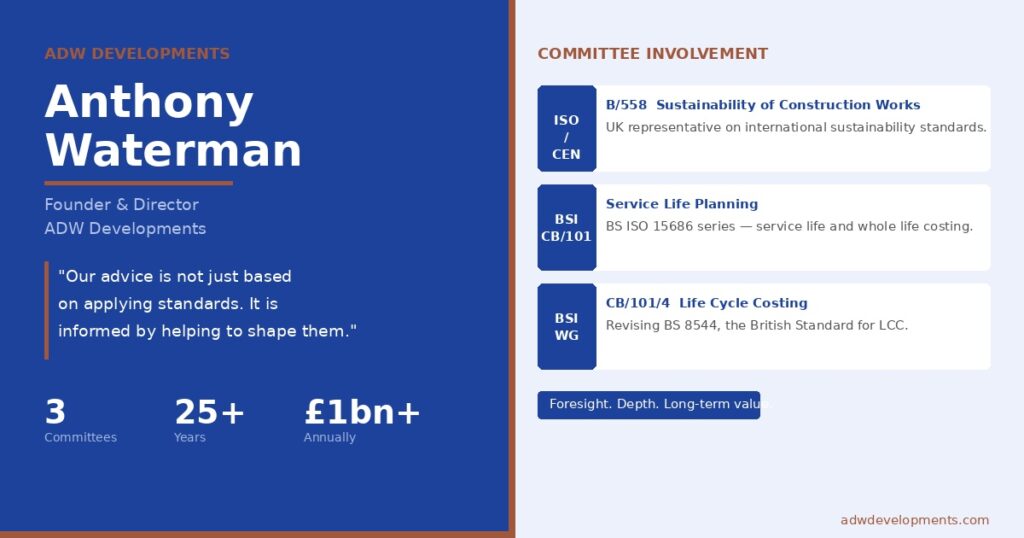
It means our advice is not just based on applying standards. It helps to shape them and, in doing so, informs them.
I represent the UK on B/558, Sustainability of Construction Works, which contributes to international sustainability standards through ISO and CEN committees. I also sit on CB/101, Service Life Planning, responsible for the BS ISO 15686 series, and CB/101/4, the working group revising BS 8544, the British Standard for Life Cycle Costing.
For clients, that provides something increasingly valuable: foresight. We understand not only what today standards require, but why they exist, how they are evolving, and where the industry is heading next. That means we are not simply helping clients achieve compliance or secure credits. We are helping them make decisions that will continue to deliver value as expectations, regulations, and market demands evolve. When you are making investment decisions that will shape an asset for decades, that perspective can make all the difference.
ADW Developments has developed its own AI tools to support sustainability and life cycle assessments. What problem were you trying to solve?
The construction industry has a productivity problem. Specialist consultants are doing complex, high-value analytical work, and they’re doing it slowly, inconsistently, and manually, much the same way they did twenty years ago.
We built tools to fix that. Not for clients first, but for ourselves. We trained AI systems on our own methodology, our own project data, and our own specialist knowledge. The result was faster delivery, better consistency, and the ability to handle more work without adding headcount.
Once we’d proven it worked, we made it available to a small number of other firms who wanted the same advantage without having to build it themselves.
The data security piece matters too. Generic AI platforms mean your project benchmarks, analytical frameworks, pricing logic, and hard-won project intelligence can end up in a shared environment you don’t control. Our systems are private, governed, and designed to keep client data within a controlled environment. For many of the organisations we work with, that’s often the deciding factor.
More broadly, I think AI will do for knowledge work what previous waves of technology did for manufacturing and logistics. The firms that learn to use it well will be able to deliver higher quality work, faster and more consistently, than those that don’t.
What does success actually look like for a client, not on paper, but in the real world?
Success is when a client makes a better decision than they would have made without us.
That might mean they specify a material that costs more upfront but saves them significantly over sixty years. It might mean they avoid a design choice that looked cheap on day one and expensive every year after. It might mean they secure approval for a Circular Economy Statement at the first planning meeting, rather than spending months going back and forth.
The BREEAM credit is almost never the point. The credit is a by-product of doing the analysis properly. What the client actually gets is clarity. They get the data they need, a comparison, and a recommendation they can act on with confidence. The real-world version of success is a client who calls us on the next project and recommends us to the design team on their project. That is the only metric that matters.
Better decisions start early. Find out how ADW can help with your project, and get in touch.