
This July, BREEAM published the technical standards for RFO V7. The manuals are out, but registrations have not yet opened, and BRE expects them later in the summer. For now, no project can be assessed under V7.
So this is not a review of a scheme already in use. It is a considered read of what BRE has actually confirmed in the published manuals: what refurbishment and fit out teams should expect, and what they can usefully prepare for. The requirements are known. Only the registration date is still to land.
That is enough to act on. The scheme has been restructured into two standards, the UK and International schemes have merged, and whole life carbon has moved to the heart of the assessment.
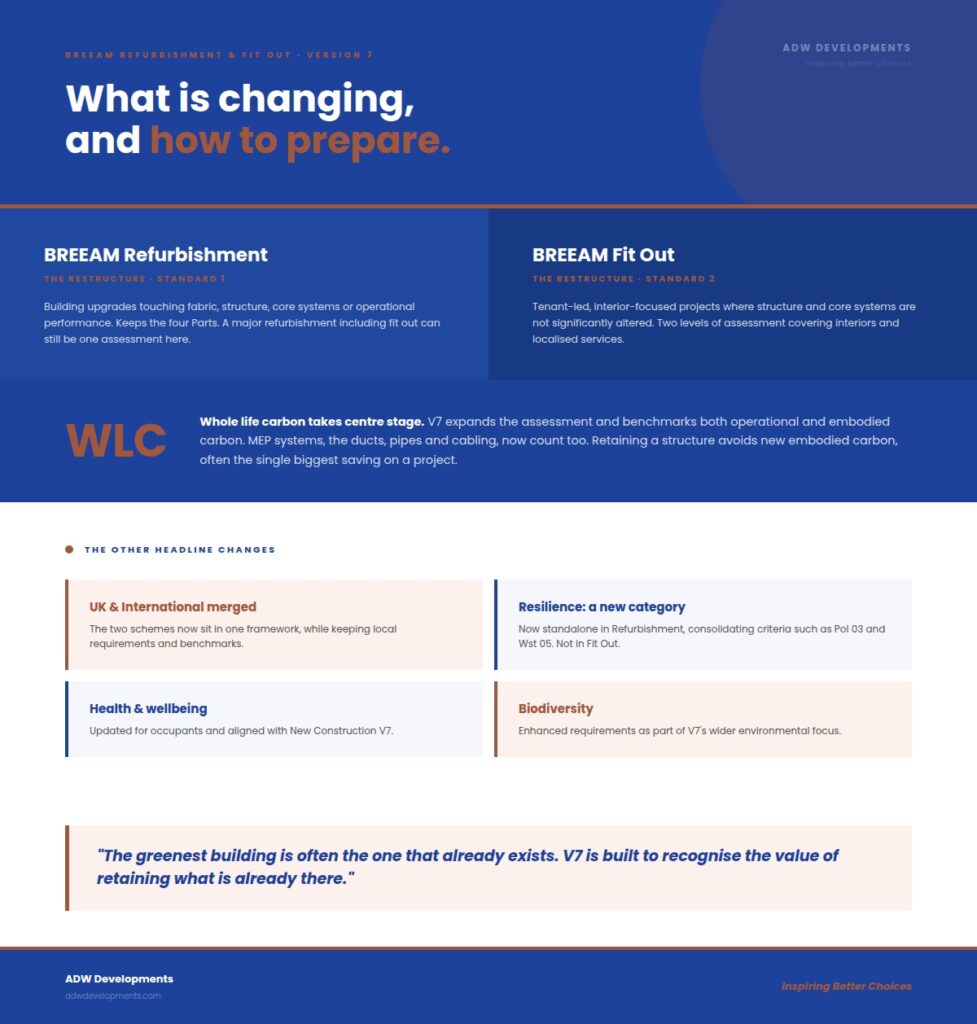
The Scheme Has Been Restructured Into Two Standards
The most fundamental change is structural. The Refurbishment and Fit Out scheme, which remains the overarching name, has been restructured into two distinct standards, each tailored to a different kind of project.
| Standard | What it covers |
| BREEAM Refurbishment | Building upgrades that may include changes to the fabric, structure, core building systems and operational performance of an existing asset. Used where work extends beyond individual spaces to improve the overall building. |
| BREEAM Fit Out | Tenant-led or interior-focused projects where the wider structure and core systems are not being significantly altered. It focuses on interior spaces: layouts, finishes, furnishings and localised services. |
BRE made this change for a practical reason. Refurbishment and fit out projects differ significantly in their scope, opportunities, constraints and sustainability impacts. Separate standards let the assessment requirements be tailored to each, which produces a more relevant and more proportionate assessment.
One point removes a common worry. A major refurbishment that also includes the fit out can still be assessed as a single assessment under BREEAM Refurbishment V7. The restructure does not force two assessments on a project that is genuinely one project. But it does mean the correct standard has to be chosen at registration, because that decision shapes everything that follows.
| The first commercial decision on a V7 project is not a design decision. It is registering under the correct standard. Choose wrong and the assessment measures the project against the wrong framework. |
The UK and International Schemes Have Merged
Running alongside the restructure is a second change that matters for anyone working across borders. The previous UK RFO 2014 and International RFO 2015 schemes have been brought together within a single scheme framework.
The combined framework still recognises local contexts, regulations and market practices, so UK-specific requirements have not been removed. Where regional differences exist, the appropriate requirements and benchmarks remain in place. What changes is consistency: projects are now assessed against a common set of principles, which improves comparability across countries and simplifies matters for organisations operating internationally. Assessors still need the relevant territory licence to register a project.
The Modular Parts Remain
Within BREEAM Refurbishment, the assessment still adapts to the scope of the works through the same four parts used in the previous scheme. A project can be assessed across any combination of them, or against a single part, depending on what the works actually touch.
| BREEAM Refurbishment | Scope |
| Part 1 | Fabric and structure |
| Part 2 | Core services |
| Part 3 | Local services |
| Part 4 | Interior design |
BREEAM Fit Out replaces the four parts with two levels of assessment. Level 1 covers interior design works, equivalent to a Part 4 assessment. Level 2 covers interior design works including local building services, broadly equivalent to a Part 3 and 4 assessment. A Part 4 only assessment now falls under BREEAM Fit Out rather than BREEAM Refurbishment.
This modularity keeps the assessment proportionate. A refurbishment that never opens up the structure is not assessed as though it did, which keeps the cost of compliance tied to the actual extent of the work. It also aligns the scheme far more closely with BREEAM New Construction V7, since the two now share the same underlying Version 7 science and approach.
Whole Life Carbon Moves to the Core
This is the change with the largest commercial consequence, and the one most likely to catch teams out.
V7 places a substantially greater emphasis on whole life carbon. V7 expands whole life carbon assessment. It introduces benchmarking and reporting for both predicted operational and embodied carbon, with a stronger focus on circular material strategies. It also brings MEP systems, the ducts, pipes and cabling, into embodied carbon assessments. That gives a more complete picture of an asset’s true carbon impact.
For refurbishment, this is where the numbers get interesting. Retaining an existing structure can avoid substantial embodied carbon associated with new structural construction, which makes it an important strategy for reducing whole life carbon on many refurbishment projects. A V7 assessment is built to capture and credit exactly that.
But capturing that advantage depends on decisions made early. The expanded carbon assessment and benchmarking requirements in V7 make early consideration important, while key design and retain-or-replace decisions can still be influenced. A carbon assessment commissioned late records what was done. Commissioned early, it can help shape what gets done.
| Retaining a structure is usually the biggest single carbon saving on a project. BREEAM RFO V7 is built to reward it. But only a project that models the carbon early can prove the saving and claim the value. |
Resilience Becomes a Standalone Category
V7 also establishes Resilience as a standalone category in BREEAM Refurbishment. Resilience-related criteria that were previously distributed across several categories have been consolidated into one, then reviewed and updated. The new category gathers past resilience-related credits, including Pol 03 and Wst 05 from New Construction V7, harmonises them, and enhances the requirements.
It is worth noting the Resilience category does not apply to BREEAM Fit Out, because the aims of its issues fall beyond the scope of a fit out project.
Resilience leads a wider set of changes that bring the scheme into line with the direction of New Construction:
- Health and wellbeing standards have been updated for occupants and brought into closer alignment with New Construction V7.
- Biodiversity requirements have been enhanced as part of V7’s wider environmental focus.
- Reporting has been streamlined to align better with internal and external reporting frameworks, with more flexible tools for data collection across diverse asset types, including mixed-use buildings.
Why This Is a Construction Economics Story
The refurbishment of existing buildings is one of the largest commercial opportunities in the sector, and BREEAM RFO V7 sharpens the case for it.
An existing building contains embodied carbon that has already been invested in its construction. Retaining existing building elements can reduce the need for new construction materials and their associated emissions. As investors increasingly consider physical climate risk and carbon performance in their decisions, a well-assessed refurbishment with a documented whole life carbon position can support better-informed investment and asset-management decisions.
The decisions that unlock this all sit early. Which standard to register under. What scope to assess. When to model the carbon. Whether to retain or replace the structure, judged on whole life numbers rather than capital cost alone. Each of these is a construction economics question, and each is best answered at the start of a project, alongside the durability and life cycle cost work that shares the same data.
Where This Leaves Project Teams
BREEAM Refurbishment and Fit Out V7 is a genuine step change, not a routine version bump.The scheme has been restructured into two standards. The UK and International schemes have merged. Whole life carbon is now far more prominent. And the assessment gives greater weight to retaining and upgrading existing buildings where appropriate.
The teams that benefit will be the ones that engage early enough to register under the right standard, scope the assessment to the real works, and model the carbon while retain-or-replace decisions are still open. The teams that struggle will be the ones that treat V7 as the old scheme with a new number.
ADW supports refurbishment and fit out projects on the whole life carbon, durability, circular economy and life cycle cost work now central to V7. Make the decisions that carry the cost and the carbon early, while they can still be shaped.
The greenest building is often the one that already exists. BREEAM RFO V7 provides a framework for assessing and improving the sustainability of existing commercial buildings, while recognising the benefits of retaining what is already there.
| Find out how ADW Developments can help you with your project. |