
Every life cycle cost model depends on a decision that teams rarely discuss in detail. Before calculating a single figure, someone has to establish how far into the future the analysis will reach. The usual options are twenty years, thirty, fifty or sixty. The question can look administrative, but it determines which costs appear in the model and which fall outside it, to be met by whoever owns the building later.
BREEAM leaves this decision with the client. Under Man 02, the elemental life cycle cost plan must indicate future replacement costs over a period of analysis as required by the client. BREEAM offers 20, 30, 50 or 60 years as examples, without prescribing any of them. The requirement is simply that the project team agrees a period. That makes it a decision to reason through, rather than a field to complete.
Why the period changes the answer
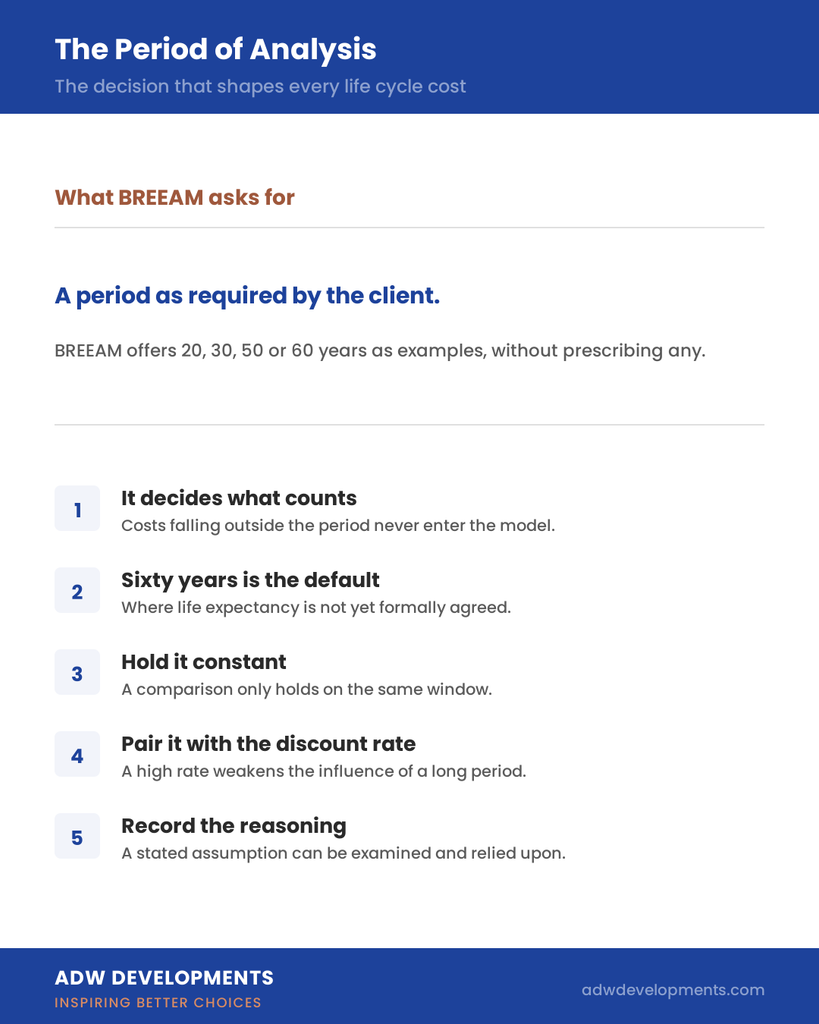
A life cycle cost model counts the costs that fall inside the period and disregards those that fall outside it. The principle is simple enough, though its consequences are easy to underestimate.
Consider a component with a service life of around thirty five years. Analysed over thirty years, it never requires replacement within the model. Analysed over sixty, the replacement appears once, bringing with it the cost and the disruption that replacement involves. Nothing about the component or the specification has altered between those two analyses. The only difference is the length of the period, and it is enough to reverse the conclusion.
This matters most when comparing options, which is precisely what Man 02 asks teams to do. BREEAM is explicit on the point. A life cycle cost must consider at least two design option appraisals, and rest on more than one cash flow scenario. Because an option appraisal compares alternatives on a common basis, the period applied to that comparison shapes its outcome. A shorter period tends to favour the option with the lower capital cost. The expensive consequences of a cheaper specification fall beyond the point where the model stops counting. A longer period tends to favour more durable options, because the extended intervals between their replacements finally come into view.
Neither result is incorrect. They are answers to different questions, and the period of analysis is what determines which question the model sets out to answer. That determination is made before any calculation begins.
What the standards say, and what they leave open
BREEAM asks for the elemental analysis to follow recognised methodology. In the UK that means PD 156865, the standardised method of life cycle costing for construction procurement. Internationally it means ISO 15686-5, the life cycle costing part of the service life planning series.
These documents define the mechanics of the exercise. They set out how to construct a period of analysis, how to discount future costs to present value, and how to report the assumptions behind a result. RICS guidance covers the same ground for UK practice, and addresses the period of analysis alongside the discount rate, since the two interact.
What the standards do not do is select the period on a team’s behalf. That judgement concerns the asset itself and the client’s interest in it, which places it with the people who hold that interest.
The default, and when to depart from it
At early design stages a building’s life expectancy is often not yet formally agreed. Assessment guidance points to a default design life of sixty years for modelling purposes, in line with the UK default.
The default is a sensible one, and for many projects it is the appropriate answer. A sixty year period reflects the design life of a typical commercial or institutional building. It is also long enough for most major replacement cycles to appear at least once.
It remains a default rather than a rule. Ideally the client agrees the study period, in line with the building’s design life expectancy. Several circumstances justify departing from it.
A client with a defined holding period may reasonably want the analysis to reflect it. An investor intending to sell after fifteen years has a legitimate interest in what happens during those fifteen years. A period that short still reveals little about the condition of the asset being sold, and any prospective buyer will ask the longer question.
A building with an unusually long or short intended life may also justify a different period. Infrastructure assets and institutional buildings frequently look beyond sixty years, while temporary or short life structures plainly do not.
A refurbishment may warrant a period tied to the remaining life of the retained structure, rather than the design life of a new building.
In each of these cases the reasoning matters as much as the figure itself. A period chosen deliberately and recorded clearly allows anyone reading the analysis to understand what it covers and what it leaves out.
The discount rate question sits alongside it
The period of analysis does not operate in isolation. Discounting converts future costs to present value, and the discount rate governs how much weight distant costs carry in the result.
The interaction between the two is straightforward in principle. A high discount rate reduces the present value of distant costs and so weakens the influence of a long period, while a lower rate has the opposite effect. Apply a long period and a high discount rate together, and the later years contribute very little to the result. A team may then believe it has taken a long view, when the model has largely discounted that view away.
RICS guidance treats the period of analysis and the discount rate as parameters to agree and report together. Neither makes sense without the other.
Getting the decision right
Three practical points follow.
Agree the period with the client, early, and record the reasoning. BREEAM asks for a period as required by the client, which means the conversation has to happen. Having it at the outset is considerably easier than reconstructing it later.
Hold the period constant when comparing options. The comparison only holds if both options face the same window. Changing the period between options produces a result that reflects the assumption rather than the design.
Report the period and the discount rate together, alongside the service life assumptions underneath them. An analysis that states its parameters invites scrutiny and supports reliance. One that does not offers neither.
Underlying all of this is a point BREEAM makes in its own definitions. Life cycle costing aims to identify the optimal option. Critical value aims to maximise the whole life value of the building based on client requirements, which differs from simply minimising life cycle cost. The period of analysis is where that distinction becomes concrete. Choose it carelessly and the model answers a question nobody asked.
At ADW Developments, life cycle costing and elemental life cycle costing are core services. We provide Man 02 life cycle cost and service life planning for BREEAM assessments. To discuss life cycle costing for a project you are planning, get in touch at enquiries@adwdevelopments.com.