
Post-Occupancy Evaluation (POE, discussed here) has moved from being an optional extra to an essential part of responsible building delivery. It is the evidence-based link between design ambition and operational reality.
While many teams now recognise what POE is, fewer grasp why it matters so profoundly. Beyond compliance and certification, POE is reshaping how we measure value, define success, and future-proof our buildings.
From to Insight: Making Buildings Work Smarter
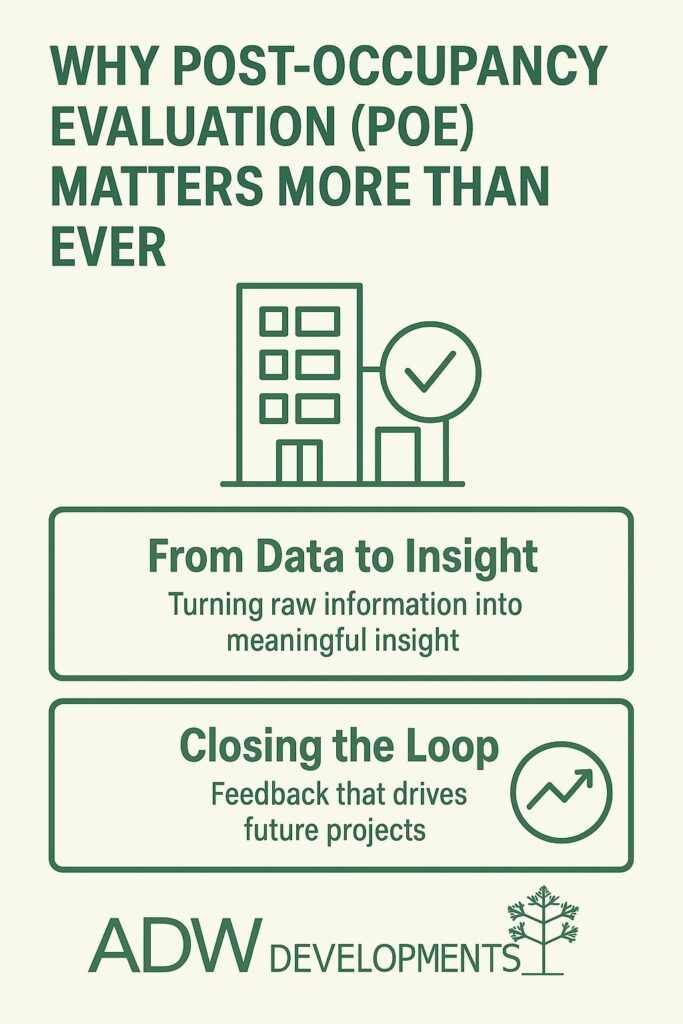
Modern buildings generate vast amounts of data, from energy use and ventilation rates to occupancy patterns. Yet data alone means little without context. POE turns raw information into meaningful insight.
By analysing how spaces are used and experienced, POE uncovers inefficiencies that design-stage modelling often misses. These insights enable designers, facility managers, and owners to make targeted interventions that improve comfort, reduce waste, and extend asset life.
More importantly, POE ensures that every adjustment is based on real evidence, not assumption.
Closing the Loop Between Design and Use
The construction process has traditionally ended at handover. Once a building was complete, lessons rarely flowed back to the design team. POE changes that dynamic.
Structured feedback creates a closed loop between design, delivery, and operation. This feedback informs future projects, helping teams refine materials, systems, and user experience with each iteration.
The result is a culture of continual improvement — one that aligns with net zero goals, circular design thinking, and long-term resilience.
Building Trust and Transparency
For investors, tenants, and end users, trust is built on transparency. POE provides the data to demonstrate that sustainability claims hold true in practice.
Measured outcomes, such as verified energy savings or occupant satisfaction scores, offer tangible proof of value. This builds confidence among clients, strengthens ESG credentials, and differentiates developers in an increasingly data-driven marketplace.
In short, POE doesn’t just improve performance; it enhances credibility.
Redefining Value in the Age of Net Zero
As the industry accelerates towards net zero, success will be measured not by what a building promises, but by what it delivers over time. POE provides the mechanism to measure, verify, and communicate that performance.
It allows developers to identify carbon hotspots, optimise operational efficiency, and quantify the benefits of sustainable design decisions. This data is critical for meeting disclosure requirements, securing green financing, and achieving long-term carbon reduction targets.
POE therefore becomes both a design tool and a business strategy.
Beyond Compliance — Towards a Culture of Learning
POE is increasingly recognised within frameworks such as BREEAM, NABERS, and the RIBA Plan of Work. Yet its greatest value lies beyond compliance.
When adopted as standard practice, POE cultivates a culture of learning and accountability. It ensures that each project informs the next, creating a more intelligent, adaptive built environment.
As building performance expectations rise, those who embrace this mindset will lead the industry — not follow it.
Looking Ahead
POE (GOV.UK guidance here) is not simply about measuring performance; it’s about understanding how buildings truly live and breathe. It is where data meets design, and where feedback becomes foresight.
At ADW Developments, we champion POE as a catalyst for smarter, more sustainable development. By embedding evaluation into every project stage, we help our clients achieve measurable performance, greater occupant wellbeing, and long-term environmental value. Contact us today to find out more.